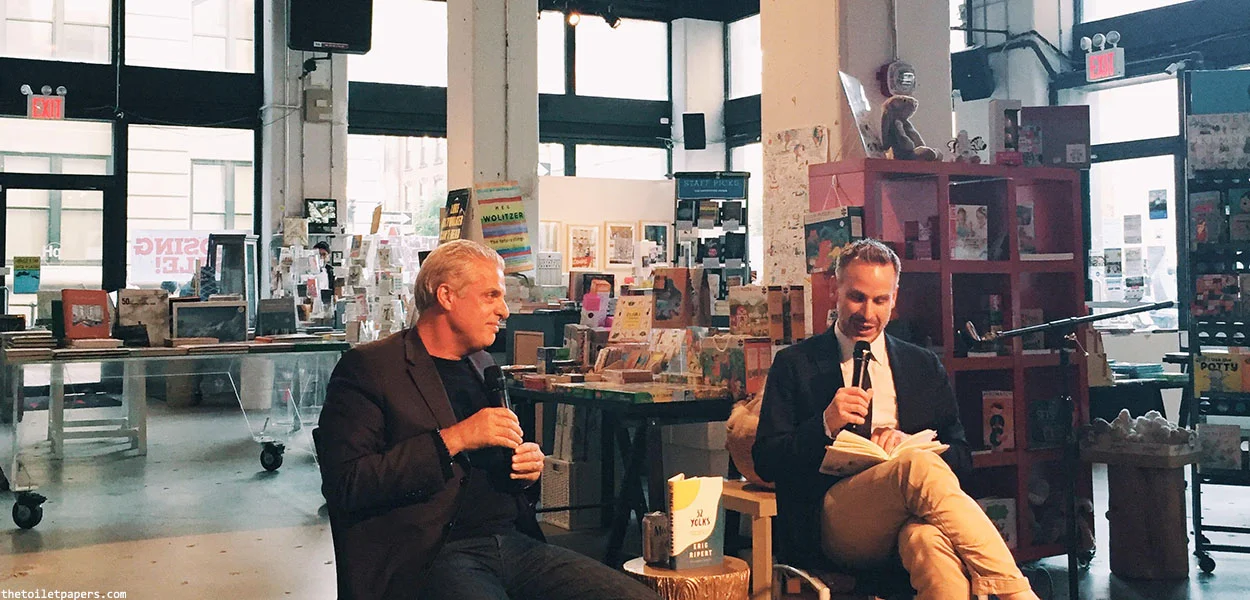
eric ripert!

160608.jpg

2016 june 08 at powerhouse arena with bon appetit's adam rapoport!  (ripert is on the left.)

i find that there are two kinds of book events (ok, really, three):  there's the kind where i'm following along with my thumbs, trying to catch as many words as i can, and then there's the kind where i'm not so obsessive, simply enjoying the moment.  i love both kinds -- there's a different kind of rapt attention they both command -- though i suppose the latter is less useful for this site.

as it goes, tonight's event with eric ripert was the latter.  ripert is basically what you'd expect in person -- he's charming, funny, open -- and it was just fun to be able to sit and listen to him chat with rapoport.  i have fewer notes from tonight, but maybe that means y'all should just goand read his memoir, 32 yolks, which i absolutely loved -- he made me cry, made me laugh, and left me feeling full and satisfied and encouraged to keep on doing what i'm doing.

(32 yolks also really encapsulated what it is i love about passion, which i posted about here.  i did a micro-review of the book here.)


adam rapoport:  what is more difficult -- working the line as a terrified 17-year-old or writing a book about being a terrified 17-year-old?

eric ripert:  writing a book is a process -- as you know, it's not easy.  thank god i had veronica.

ER:  working the line in the 80s was terrifying.  i was the youngest one in the kitchen, and i was coming from culinary school and realized that i wasn't really at that level.

AR:  i mean, you were kind of an idiot in the kitchen at first.  [on his first day at la tour d'argent, ripert cut his finger.  then he failed to make the hollandaise.  then he didn't know what chervil was.  in two weeks, he poured a pot of lobster stock on himself, badly scalding his feet.]  what made you think you knew how to cook?

ER:  [re:  the chervil]  in culinary school, you don't have expensive ingredients to cook with, so, often, they replace the ingredients with something else.  [if they were able to get fish or meat, everyone in the class would get a little bit.]  you have exposure to the knowledge, but you don't really master the recipe or the technique.

ER:  [re:  writing about his childhood]  i wanted to put it in the book because i wanted the book to be inspirational on many levels and potentially touch people who are having problems as a couple or as children.

AR:  you were an only child.

ER:  yes.

AR:  and you have one child.

ER:  yes.  [...]  i have one child for different reasons.

AR:  what's interesting in the book is how vividly you write about food at such an early age.  were you really that attentive?

ER:  oh, yes.  when i did the book, i realized that my long-term memory is amazing, and i can remember from three-and-a-half years old vividly.  my short-term memory is destroyed.  especially when it comes to food, i remember everything, every detail.  for me, it's very easy to go back into those scenes and go into those details like we did for the book.

AR read a passage from 32 yolks:

there are dozens of lakes in the mountains of andorra.  during our years living there, we'd gotten to know which waters had the most trout to be caught.  [...]  my mother would poach the just-caught trout in a big pot set over a camping stove.  when the fish was almost done, she would add a dash of vinegar to the court bouillon in which she was poaching the trout.  that burst of acidity caused the skin of the fish to turn blue -- a rare delicacy i'd read about in one of her cookbooks.  then she would reduce the liquid, emulsify it with a little butter, and serve it as a sauce for the fish.  (88)

AR:  who reduced a sauce on a camping trip?!  did you think this was normal?

ER:  yes!

ER:  [re:  fine dining]  i loved the formality of the staff.  i loved that it was this entire room, and there was this valet of people serving people, and i had a passion for that.  look, for me, i was born with passion, so i recognized that --

AR:  did you know that when you were that age?

ER:  yes.  i knew i had a passion for eating but not so much for cooking -- that would come later.

AR:  why did you think you were not a good student?

ER:  for many reasons.  one of them, when i was seven years old, i was so good in school, they made me jump a grade.  when i went to the following grade, i was completely lost, and, moving on, i was always behind, so i started sitting in the back of the class and became the clown.  in culinary school, i excelled.

ER:  cooking is craftsmanship.  artistry comes later on.  when you have mastered all the craftsmanship, then you can start to be creative and have artistic visions, and, when you have the visions, you have the technique to back them up.

[ER got his job at la tour after he wrote to all the michelin-starred restaurants in paris after culinary school.  la tour is the only one that replied.]

ER:  it's virtually impossible to come out of culinary school onto the line of a michelin-starred restaurant.

[why is his memoir titled 32 yolks?  on his first day at la tour d'argent:]

tirade over, he [maurice] asked me to make the hollandaise, adding, as though it was nothing, "thirty-two yolks, okay?"

"oui, chef," i dutifully replied.

this seemingly easy task would be the thing that broke me, showing me the gap between culinary school knowledge and real restaurant chops.  to start, it took me almost twenty minutes to separate the eggs.  none of the guys around me lifted their heads from their stations when i asked what to do with the whites.  they were too deep in their tasks, moving with a smooth, mechanic urgency as they prepared their mise en place for the first service, slicing leeks as fine as eyelashes and "turning" carrots into perfect barrel shapes.  stopping for ten seconds to answer a basic question was unthinkable.

when i approached the waldorf with my pan, the hairs on my forearms curled up and singed into nothing.  i tried to negotiate for my own twenty inches of space with a cook who was calmly adding lobsters to a massive pot of stock.  but even then, i didn't have the strength to move thirty-two yolks and make a light and foamy sabayon.  i didn't know to feel the temperature of the pan with the back of my hand.  i didn't know how to instinctively intuit the right temperature to cook the eggs so that they would become that magical sauce.  i didn't know and i couldn't ask -- this was la tour, not cooking school -- so i failed, at the simplest of tasks.  maurice was so shocked when he discovered my incompetence that he said nothing, just took the pan out of my hand and looked upward, as if demanding celestial intervention.  (124)

ER:  it took me weeks, maybe months, to master the sabayon, and, by the time i mastered that, [i had become part of the kitchen].

ER:  i didn't want to do anything else.  i had a strong passion to be a chef, and i knew i had to pay my dues.

ER:  anyone in a professional kitchen can't do much by himself.

lucy kalanithi!

kalanithi-1.jpg

2016 may 9 at random house:  lucy kalanithi is the widow of paul kalanithi, a neurosurgeon who passed away from cancer last year.  he loved literature and studied english in college, and, after he was diagnosed, he wrote two beautiful essays, the first in the new york times titled "how long have i got left?" and the second in stanford medicine a few months before he passed, "before i go."  his book, when breath becomes air, was published by random house this january.

lucy kalanithi is an incredible woman -- poised, articulate, thoughtful.  she wrote a poignant piece for the new york times, "my marriage didn't end when i became a widow," and she's an internist who is also involved in changing the ways medicine approaches end-of-life care/decisions.

she was in conversation with glamour's liz egan.


liz egan:  this book has been out for exactly four months.  can you tell us a little bit about how your life has [changed or not]?

lucy kalanithi:  it's funny because today is exactly fourteen months since paul died, and this book, for our family, has been one of the best things, and paul would have been thrilled to see what has happened and the conversations it's generated.  it's kind of a disorienting time for me, too, because it's kind of weird to be public but also to be so lonely at the same time.  being a doctor, the topic's are near and dear to my heart, too, so i can see my future stretching out in ways that i didn't expect to, so the book isn't just the past but also the present.

LK:  i did this early interview with a reporter from elle who said, "so, this might end up on people's shelves next to the year of magical thinking," and i was like, "are you serious?"  [...]  andy ward, the editor, wrote [paul] this really nice letter saying that [random house] would approach [the book] to get it to be a new york times bestseller, and paul was like, "seriously?"

LK:  he was writing it as a journal but also to bring people into this experience.

LE:  his first step onto the world stage was i believe january 24, 2014, when he published a piece in the new york times called "how long have i got left."

LK:  it was surprising and great.  there was that essay, and there was another, and that was the one that ends with a love letter to our daughter, and he was around to see the response to that.  [at the time, paul was pretty much restrained to their home.]  to have this social media response to an essay -- social media really enables you to feel like you're participating in the world; it's one of the great things it can do.  he was grateful for that.

LE:  how did you find the courage to write [your new york times] piece?

LK:  it was -- again, paul really liked the process of writing, and i find it a real struggle and had a lot of help with those essays.  i felt like my heart ended up on the page, and that feels amazing to have that.  when i was working on that piece, someone gave me the advice that the more sensory detail you can give, that's what makes it really universal, that people can empathize with it.  when they asked me to write the epilogue [to when breath becomes air], i didn't know if i could do that, if i could follow paul, and, if he could have done it, to write about his death, he would have done that.  it felt, as with everything else, like doing a service to him.

LE:  there was a phrase in your epilogue -- you write about the ways in which you took care of him, and, also, you said, "with music and the simple act of witnessing."  can you talk a little bit about why it's so different and also why it's so important?

LK:  i think that when someone is really ill or terminally ill, all you can do a lot of the time is just sit with it.  and being able to do that for someone else -- "i'm here for you no matter what happens."  "i'm here with you."  paul and i escaped a lot of emotions, like anger, [but there were other ones] and i think we could just with them.

LK:  [did an interview with charlie rose earlier in the day]  he [charlie rose] asked, "what do you regret?", and i said i didn't have much to regret because we sat in the muck together and talked through it so much.

LE:  how would you respond to all the people -- when someone is that sick, there's always someone who wants to assure you that you will get better, you'll be all right.  i think it takes some bravery to sit with it and say that, no, there is no happy ending, this is it.

LK:  paul's parents were in that camp, and i think that narrative helps some people.

LE:  how would you handle that?

LK:  i think, for me, that narrative was less helpful.  i think it's a human response -- even in medicine, the way we talk about things are hopeful.  i wouldn't begrudge someone that because whatever narrative that helps you cope is fine.

LE:  i think people always want to know what they can do.  are there things you would say to those who know someone who is [ill]?

LK:  what paul found really helpful was people showing up and acting the ways they did before.  [not like pretending everything was okay.]  like, his friends were really humorous and made a lot of jokes, and they would come and make jokes about the bed rail.  just because you're sick doesn't mean you're not you anymore.

LK:  my mom has this great advice:  when it doubt, describe.

LK:  i think, after paul died, people are afraid to talk about him.  but the person left behind is always thinking about it.

LE:  he wrote so much about language and what he loved reading.  are there books that you've read that have been particularly helpful?

LK:  when we were decided to have a baby, i read far from the tree.  it's basically about -- andrew solomon embarks on this quest to -- he himself is both gay and dyslexic -- and he learned that his mom was really supportive about his dyslexia but not about him being gay.  each chapter is about how a child is different from a parent.  the upshot is that he thinks that most families are really resilient and will do anything for each other.  in the end, he and his partner decide to have children.  it deepened my desire to have a child.

LK:  since paul died, i've read some poetry that's been really nice.  there's this really long elizabethan poem ["caelica 83"] that the epigraph of paul's book is from and the title is taken from.  it's greville mourning the death of his friend, and he just goes on and on and on about al the things he misses.

LE:  [mentions w.s. merwin's "separation" and quote it]

your absence has gone through me
like thread through a needle. 
everything i do is stitched with its color.

LE:  did he leave a book for you?

LK:  no.

[he left a book for his parents, the title of which i apparently did not write down, but, if i can find it, i'll update this.]

LK:  that book is actually really helpful.  it's super christian, and it's super agonizing about losing a son, and one of paul's friends sent it to him when he was diagnosed, then he wanted me to give it to his parents, which i did.  they both read it, and his dad carried it around for weeks, kind of like an amulet.

LE:  you have now been interviewed many times.  is there a question you wish you'd been asked?

LK:  i don't think so, but i say this because i've learned this technique where you can say whatever you want to whichever question.

LK:  when i started doing interviews, i was afraid that people would treat me with kid gloves.

LE:  do you feel you've entered the new normal?

LK:  not quite.  again because this has been so topsy turvy.  although this funny thing happened when paul got sick, that the future shrank down.  i knew we had months to a couple years, so the future was a lot shorter, so i learned to live in the present.  so i haven't really learned to live in the new normal, but i'm okay with it.

kalanithi-2.jpg

[audience Q&As]

LK:  even when we got engaged, he was going to be a psychiatrist, so i thought i was going to marry a literary psychiatrist.  so he really surprised me and his friends when he decided to become a neurosurgeon.

LK:  i don't love the operating room.  it's freezing cold; there are no windows; and the patient's asleep -- it's just not my scene.  you have to love it to be a surgeon.  he loved it.  i think the physical technical aspects of it didn't come as naturally to him as it did for other people.  like, he was a terrible driver -- he would be so mad at me for saying this -- [so he had to work hard at it].

LK:  there were three charities we found really helpful.  [lung cancer]'s a weirdly stigmatized illness, so the charities -- i love the lung cancer communities.  it's a very strong and compassionate community.  we liked team draft, and paul's oncologist really liked an organization called free to breathe, and there's another one called bonnie j. addario lung cancer foundation.  they were really helpful to us, even being doctors.

LK:  one of my attendings once said, "sometimes, it's nice to start a sentence with 'i wish,' like 'i really wish you could be cured" -- so you get out what you want to express while realizing you probably won't get it.

LK:  i think there is so much you can provide and you are providing just by being there and someone knowing you're there.

LK:  his death makes me really feel and empathize with the disorienting [aspect] of being sick.  so i feel encouraged to explore that space with patients and to think about -- there are all these things we can do with medicine, but what can do to maximize thins for you?  also, [within medicine], i get to talk about end-of-life care, so being able to talk about that is really compelling to me and gives me a sense of purpose going forward.

LK:  i think being in medicine -- once i entered medical school, i felt like that was a point of transition for me, so i think practicing medicine made me more present in a certain way.  and paul talks in the beginning of the book about troubles we were having in our marriage and how we were missing these attempts to communicate, so i think [we were] probably less present [then].  so i think this will change me going forward, but i think [being present]'s a challenge for everyone.

roxane gay!

160501.jpg

2016 may 1 at the pen world voices festival:  roxane gay was invited to deliver the arthur miller freedom to write lecture, after which she was joined by saeed jones.  i didn't take notes during her lecture (which was incredible), but i did during the conversation, which was obviously amazing.

saeed jones is a poet and the culture editor at buzzfeed, and he's currently working on a memoir.


saeed jones:  i want to say thank you because your work is about freedom, and it does come at a cost.  and i was wondering -- in moving from an untamed state to bad feminist and, now, to hunger, how have you worked to deal with negotiating the vulnerability [in the undertaking of this offering]?

roxane gay:  every time i write something, i tell myself no one's going to read this.  for a while, that delusion was perfect.  i try to have boundaries about what i will or will not write about, and i allow myself to have responses to criticism about my work.

RG:  when you put yourself out there, you'll be criticized both for your work and how you present yourself.  [...]  i'm constantly trying to work against the way the media tries to represent my work.

RG:  i read a review of hunger ... that i haven't turned in.

RG:  i try to make sure to remind people that i'm not in control of the narrative that's put on my work once it's out in the world.

RG:  i don't mind being someone people can look up to.  i very much respect that.  it's uncomfortable and weird because i'm me.  and i watch a lot of HGTV.  i tweet about HGTV so much that someone from HGTV emailed me.  it's like, oh, now i'm living the dream!

SJ:  something i was thinking about [beyonce's] lemonade -- how she willingly puts herself in the context of generations.  do you see yourself in a lineage of writers who have regarded their body as a text?

RG:  oh, absolutely.  especially toni morrison, the way she writes about the black woman's body.

RG:  one of the challenges of when you're an underrepresented person is that certain people believe that there can only be one.

RG:  money doesn't buy you freedom from pain and from ridicule and from being distorted, and money has never bought a black person freedom from being a target.

RG:  i think it's important to recognize that, when you've achieved a certain amount of respect, that you [have to pay it forward].

RG:  if your creative world is only you ... then you're not very creative.

RG:  first of all, i'm reading because i'm like that's my competition.  [laughs]  but also, you have to be aware of the conversations because you can't be part of the conversation if you don't know what's going on.

SJ:  [white men are] praised as though their offerings are the shoulders upon which civilization rests.  the best praise women get is that, oh, she's following in his footsteps.

RG:  [re:  knaussgard and how his confessional writing is praised as literary genius when it would be looked down upon had he been a woman]  i mean, it's fine -- if you want to read him, do you.

RG:  we have to continue pointing out that the rules are different, and we have to do something about that.  and we're in the problematic position [where women can only be experts on themselves].

[she gave an example of a woman who might be an expert on a scientific field, but, still, she would be told something like, "can you write about that scientific field and menstruation?"]

SJ:  people are eager to say we're in this transformative moment.  we certainly are in a moment of a lot of conversation about diversity ...  do you think things have changed in a way that will matter in a way five years from now?

RG:  not yet.  [...]  why do we keep talking about the problem when we know it's there?  publishing needs to do something about it.

RG:  what's also frustrating is that all the people i know in publishing are great.  so i just don't know where the disconnect is.

SJ:  even in hollywood, it seems like people are smart enough not to go up to actors and ask how to solve problems of race or gender.  they at least go to directors and producers.  if you were to design a better roundtable or panel, what would you do?

RG:  i would not [do that].  [...]  what i would like is for publishers, for the next year, to hire only people of color.  and pay them a living wage.  you can do targeted hires, and i think publishing needs to start doing targeted hires.

RG:  i'm so done with the diversity question.  i'm more interested now in problem-solving and making people feel bad.

SJ:  [asked a question about roxane's willingness to be herself], which we're often told that we can't do if we want to be a successful writer.

RG:  it's a little easier because i get to do more of what i do without having to justify it.  in grad school, i remember reading derrida and lacan and just being like ... ughhhhhh.  and they were brilliant, but no one's going to read them.

RG:  culture exists on a spectrum.  i think that, if we can change pop culture, we can trickle up because trickling down has never worked.  but maybe, when we've changed the culture, people will look and see there's diversity on television [...] and it keeps moving upward.

RG:  i love ina.  she's so amazing.  her hair's so shiny, and she has her perfect little bob, and she wears the same shirt everyday, but it's a different color, and she gets them custom-made but she won't say where.

RG:  i love being open about what i love.

RG:  the best advice i ever got -- i'd just gone on the job market, and my friend told me, "just be yourself because you don't want to have to pretend to be who you were in the interview for the next twenty years."  because academia is forever.  ish.

RG:  these things that people call lowbrow but i call awesome.

SJ:  i know you're still working on hunger --i'm working on a memoir now, too, and it's an incredibly transformative experience.  have you learned anything?

RG:  i think the book forced me to be honest with myself.  [and to realize i needed to change.]  and i don't know what that change is going to look like, but i know that i'm ready.

RG:  it's the hardest thing i've ever had to write, but i think it's also the best thing i've written.  [...]  i think it's the only memoir i'm ever going to write.

[audience Q&As]

RG:  you can't control what other people think.  you just have to do you.  there is literally nothing you can do.  you can [change all you want], but there are people who are going to think of you as stereotypical.  so you're asking the wrong question; you need to ask how you can be more comfortable being you.

RG:  we're not the problem.  the problem is the people who want to do harm.  there is nothing more that we can do to establish our humanity than by existing.

RG:  [re:  kim kardashian's posting of a nude photo -- is it body positivity or what?]  i think it's a marketing ploy.  kim kardashian is one of those people who got famous for doing nothing but being very enterprising.  [...]  of all the kardashians, kim is the most attached to kardashian-ism.

RG:  the only thing you can do to help yourself is to write and to be relentless about putting your stuff out into the world.  the only person you need is you and then you need a little luck.

RG:  it's easier to be who you are than you you've pretended to be.

RG:  [re:  the small, boutique publishing houses that have popped up -- is that a solution to the diversity problem?]  no.  i think that lets big publishing off the hook.

花見, lit. "flower viewing," an annual tradition.

the time the cherry blossoms bloom is one of my top three favorite times of the year; once the weather starts warming up, i start obsessively checking the brooklyn botanic gardens' website to see how the cherry blossoms are doing, if they've started blooming.  i didn't catch the blossoms in peak bloom this year, but it doesn't matter -- they were still beautiful and lovely to behold, delivering the same sense of calm and comfort and joy they always do.

i love the cherry blossoms, so here are some photos (taken on my iphone) (one of my things to do this year is invest in a proper camera), along with a quote that has nothing to do with cherry blossoms or flower viewing but has to do with plants so that's close enough for me:

"plants can read human minds," he [father] explained, as serious as if he were giving a science lesson.  "it's inexplicable, but i've heard that plants have keen awareness, beyond the five senses.  i once read an article about oak trees trembling in fear as a woodman approached and about red radishes becoming pale with terror as a rabbit neared.  yes, plants are alive with emotions.  they feel pain, sadness, and happiness.  and they know by instinct whether a person lies or speaks the truth.  a feigned love doesn't provoke a reaction from them.  as with people, you should be truthful when communicating with plants."

lee seung-u, the private life of plants (81)

hanami-1.jpg
hanami-2.jpg
hanami-3.jpg
hanami-4.jpg
hanami-5.jpg
hanami-6.jpg
hanami-7.jpg
hanami-8.jpg
hanami-9.jpg

patti smith + viet thanh nguyen and vu tran!

160419-smith.jpg

2016 april 19:  patti smith at the graduate center.

patti smith was in conversation with kevin baker, and she was at the graduate center as part of a festival commemorating the 70th anniversary of camus' only visit to the states.  it's always such a pleasure to hear patti smith, even more so when she's talking about the writers and books she loves.

again, did a pretty crappy job recording questions.  ^^


[before the program started, patti smith said that she had a horrible case of the allergies, so, "if i start coughing, don't worry -- it's not catching."]

kevin baker:  how did you get introduced to camus' work?

patti smith:  well, the truth is i loved french literature, and, if you were french, i was going to read you -- it was that simple.  i don't know; i just really liked the titles of the books.  the original title of the stranger was the outsider, and i was arrested by it.

KB:  he's a great observer.  do you feel he influenced you?

PS:  oh, absolutely.  and it's truthfully entirely literary -- i'm not a political writer ... but his writing style, it's just -- i just understood it.

PS:  i know it might seed conceited, but, as a young person, i aspired to walk in his tracks if i could.

KB:  it struck me that he writes a lot about metamorphosis.  and that's also a thing of yours, it seems to me.

PS:  i guess so, but i never thought about it.

PS:  the idea of metamorphosis has always been comforting to me because it gives us this sort of idea that we have another chance.  metamorphosis or resurrection, whatever you want to call it -- another chance.

PS:  the idea of death seemed so terrifying to me, and a happy death helped me find some kind of reconciliation.

KB:  was there a particular reason?

PS:  i was so ill as a kid, and i heard countless times some country doctor telling my mother, "i don't think she's going to make it."

PS:  i didn't want to die because there were so many books to read.  there were a million books i hadn't read, so i had a lot to do.

PS:  [about a happy death]  it's like all the hubris of youth that suddenly in the end very quickly evolved into a different place.

KB:  people say that your work sounds kind of like a french novel-in-translation.

PS:  i'm not like a big proust reader -- i mean, i plow through proust, but those long, long sentences ...

PS:  i don't think writing is ever easy.  writing is torture.  [...]  there are moments you think you're a genus, but that's disproved the next day.  writing is labor.

PS:  when i was living in the twentieth century, i mourned that i wasn't living in the nineteenth century.  now the twentieth century seems so innocent.

PS:  when you're writing, you create an atmosphere that the reader can enter like gumby.

PS:  being profound isn't really my biggest ability [KB:  au contraire!], but, when i'm performing, risk is always part of it.  part of the battle is that you have to communicate with the people.  you have to rein in.


2016 april 21:  viet thanh nguyen and vu tran at the brooklyn public library as part of the international writers series.

this was an incredible event with two smart, well-spoken, thoughtful writers.  my little asian-american writer heart was bursting as i walked home afterwards.

i gave up on trying to record any of the questions.


vu tran:  i guess i've always had these conversations with my vietnamese friends who are also writers.  when i said that to the new york times*, i felt kind of guilty because i hadn't engaged with it on a deeper level.  i had guilt on my part because viet has always been doing that -- he's been doing that in his criticism work.

*  i'm trying to find this interview.

viet than nguyen:  (started this vietnamese arts organization that grew into this bigger representative of vietnamese arts and cultures)

VTN:  to me, that's really crucial because obviously the work of writing is something to do on your own but so many people need a community for sustenance.

VT:  what's also really important about it, though -- at lease, for me -- i grew up in oklahoma, and i didn't have any vietnamese friends -- i didn't have any asian friends, let alone vietnamese friends -- and i feel like you end up sitting not in a vacuum but in a context you don't always need.

VTN:  when i was in college, i wanted to write on vietnamese literature, but there was very little [of it].  it's incredible to see this explosion of vietnamese literature and vietnamese literature-in-translation from the last thirty years.  there's a lot for people to read out there, who want to read more of vietnamese literature and participate in this community.

VTN:  sometimes, vietnamese-american writers write about vietnam, sometimes they write about different things.

[re:  genres]

VT:  i wrote that short story -- the second chapter in dragonfish -- and i felt that narrative -- the crime narrative, if you will -- didn't feel fleshed out to me.  there were some characters with this backstory i thought i'd investigate.

VT:  the crime framework became primarily something -- we all read mysteries because of the kind of ambiguity of the story and the shadows that can never be resolved [...] and i thought that was kind of an interesting framework for a story about immigrants.  because immigrants do that.  we walk around with all these stories from our parents, our grandparents, and we don't want to share everything.  [thus creating a natural ambiguity and maintaining shadows.]

VTN:  i always loved genre fiction.  i don't look down on genre, and it's really weird to me that, in this literary world of new york, we sell a lot of genre fiction [but put literary fiction on the pedestal].

VTN:  i'm scared of reading genre fiction because i know that, if i pick up a jo nesbo novel, i'm not going to put it down.

VTN:  what i'm most excited by are books that mix genres and aren't easily contained.

Q to vu:  why a white-american protagonist?

VT:  he needed to be a white-american because i guess i was playing with two things.  one was the narrative that i think we're all familiar with -- a white westerner comes into the native community, and he's the one who saves them.  but, also, there's the conventions of crime fiction or the detective novel, in that i was interested in the detective who wasn't very good at detecting -- and, in my mind, those two narratives tended to overlap.  in my book, i think what robert [the protagonist] does is that, because he doesn't get access to this woman he loves so desperately, he creates this other narrative for her, which is that she's crazy.

VT:  i don't let [robert] learn that much [about her] because, sometimes, you can't get all the answers to your questions.

Q to viet:  in the sympathizer, you wanted him to be the anti-hero.

VTN:  anti-heroes are the privilege of majority culture, majority writers.  you have the full panoply of representation to you as the majority.  if you're the minority, you have the burden of representing your community.

VTN:  why would my anti-hero be all of vietnam?

VTN:  the novel was deliberately set up to be a confession from one vietnamese person to another vietnamese person.  i think it's easy for writers of minorities to write to a white person because publishing is very white.  i rejected that.  [...]  what is translated [in the book] is american culture to the vietnamese.

VTN:  my experience has been that americans as a whole don't know anything about us.  on one hand, there is a very large refugee community, but, on the other hand, it's very invisible.  we had this whole interior life scattered across the country, and no one knew about them.

VTN:  when i was growing up, in every pho restaurant, there was this clock, and that just affirmed for me that vietnamese people are very conscious of time.  

VTN:  i grew up with my dad constantly telling me we're one hundred percent vietnamese.  [...]  the second time [my parents visited vietnam and came back to the states], my dad said to me, "we're american."

VT:  in my book, i think of vietnam as this animating but debilitating shadow that follows all these characters, whether they wanted it or not.  with my characters, it was more, at least with suzy [the vietnamese wife] i think that -- she abandons her daughter, and i think vietnam is embodied in this one act.  it's something she feels guilty about, but, at the same time, she knows it's something she has to do.  that tends to happen -- it'll be like one particular experience or one fact that ends up, in a way, if you're displaced from your country, that becomes representative of that in your memory.

VTN:  another [thing] that minority writers are expected to do with this refugee narrative is that, in the end, the characters are americanized.

VT:  i [wanted there to be] not literal ghosts -- i want the reader to question whether these are actual ghosts or not.  the thing i was thinking about is that, when you talk about magic realism, that kind of magic is diffused in that culture.  i thought that american culture -- they don't actively believe in ghosts in ways that other cultures do.  and, in many ways, i think that has to do with religion.  i wanted that spectre of ghosts to be something that weights on the characters a bit in different ways.

VTN:  haunting is so much a part of the legacy of war.  haunting is real, even if ghosts aren't.  if the parents are haunted, oftentimes, the children are haunted, too.  and i wanted to make that quite literal.

VTN:  if you look at so many immigrants -- filipinos, cambodians, koreans, laotians -- so many of them came here because americans fought wars in their countries.  but the american dream doesn't remember that.

VT:  i feel like the melting pot is an idea that goes back to the huddled masses yearning to break free, and it goes back to this idea of immigrants coming here to make things better for their families and assimilating -- but that melting pot doesn't leave room for those who were forced to come here.  if you believe in this notion of the melting pot, it's not just something that builds things; it destroys something in the process -- you're erasing something in the process, and that's detrimental to those people.

VTN:  we blame refugees because they're easy scapegoats for problems in society, for these problems we've caused in other countries.  it's very important to remember that the refugee narrative is very different from the immigrant narrative.

VTN:  i know [that the pride vietnamese are showing in my book after winning the pulizter] is more of a symbolic appreciation than a literary appreciation, and i'm okay with that.

VT:  i got the chance to change my name when i got my citizenship in the sixth grade, and i wanted to pick scott, but my mom stopped me, and i'm very grateful for that.

VTN:  the job of writers is to destroy the cliche.