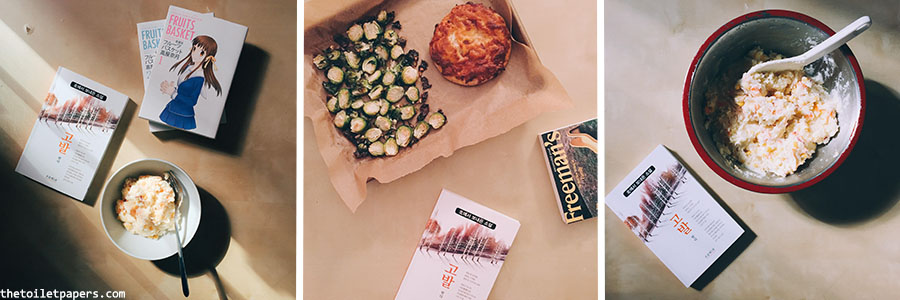
the accusation, part one.

160412-bandi-1.jpg

let's start by stating the obvious:  dear lord, it's hard reading in another language, even if it’s a language you grew up with.  these posts about the accusation are inevitably going to be as much (or more) about reading in korean as the stories themselves because reading is proving to be an adventure in and of itself, so here’s a little background about my korean.

technically, korean is my first language.  my father came to the states to do his ph.d after he graduated from seoul national university, and he didn't actually plan to get married here, was going to go back to seoul once he'd finished his studies.  he met my mum, though, (she immigrated to the states when she was ten), and, by then, his parents and four of his five sisters were stateside as well, so my parents got married, committed to a life here instead.

my dad understandably wanted his children to know korean, to be connected to their ethnic heritage and roots even if they were raised in the states.  the intense part of it was that he was so dead-set on this that he wouldn't let my mum teach me english at all, only korean, which was fine when i was a tiny little kid in jersey because both my parents worked and i spent much of my days with my paternal grandparents, neither of whom spoke english.  when i was four, though, we moved out to california, away from our extended family, to the suburbs of los angeles where my parents, of course, enrolled me in an american preschool.

(a few years later, they enrolled my english-speaking brother in a korean preschool ... my parents, lol.)

once i started school and learned english, i might have lost my korean had my paternal grandparents not moved out west to live with us.  the result was that i grew up amazing koreans with my ability to speak and understand korean -- and i say "amazing" because koreans really expect nothing from korean-americans as far as korean goes (i also lack the accent that would otherwise automatically label me korean-american).  weirdly, though, it was that ability to amaze that always made me feel self-conscious because my korean has never met my personal standards for excellence -- i'm hyper-aware of the limitations of my korean, constantly frustrated by my limited vocabulary, and i've always wished i was more fluent, a better speaker, and infinitely better reader.

regardless!  i can understand, speak, read, write to what my career counselor in law school told me is "conversational ability."  i comprehend roughly 75% of korean dramas (set in contemporary times).  previous to the accusation, i've read one novel in korean, kim young-ha's memory book of a murderer, and i had less difficulty reading that than anticipated, vocabulary gaps and all because, for the most part, i could fill in the blanks.  technical speak and business/political jargon are beyond me, though, which brings me to ...

the accusation.

the first story was more difficult than i anticipated.  the vocabulary was tougher, partly because of political terms and partly because of words that are either outdated or unique to north korea.  the korean publisher included definitions for the latter in parentheses, for which i am grateful -- and for which my dad's also unknowingly grateful because he was spared what would have been a fair number of texts ("what does xxx mean?  what about xxx?  and xxx?").  that said, while i had no problems understanding the story overall, there are definitely details that i missed; the primary example is that the narrator's father is punished for what i assume is anti-party something; but the precise political terms still elude me (and my dictionary).

also, wow, i'm slow.  painstakingly slow.  i read korean out loud, which slows me down more but helps me process, and it's good in that it forces me to read not only every single word but also every single freaking character -- i can't rush through passages (not that i could even if i wanted to), and i have to be 100% fully engaged, which admittedly isn't always the case when i'm reading in english.  i have slowed down considerably when i read in english, compared to ten years ago when i'd speed read like crazy (rather impressively, if i say so myself), and i do take in every word, but i can read and comprehend while also having other thoughts simmering in the back of my brain.  i can't do that with korean.  if i did, i'd be taking in sounds with very little meaning.


one weird thing i struggled with in this story:  names.

sometimes, on the rare occasion a name was mentioned (and not many were), i'd go to highlight it only to realize that it was someone's name, and, to be completely honest, i didn't even get the narrator's name until 3/4 of the way into the story.  i still don't remember what his wife's name is, if it were even mentioned.  i had no problems with the nephew's name, though, but it's a name also commonly found in the south, so there's that.

(fun fact:  rhee is a common surname in the north but is uncommon in the south.)


(this whole north/south delineation makes me feel squirmy and sad and furious inside.)


“탈북기" (pronounced "tahl-book-gee," "g" like in "god") means "the record of a north korean refugee," and the story is told essentially in two parts -- the first is narrated by the husband, il-cheol, who discovers that his wife is on birth control but doesn't confront her about it, suspecting her instead until he finally has to address her "suspicious" activity.  she gives him her diary to read, and the second part is taken from that as he comes to learn how much his wife has actually thought of him and grieved on his behalf and his nephew’s.  il-cheol's father was banned/exiled for (as i said above) anti-party something, and, as is the case in north korea, not only was the father punished, but that black mark has also been placed on his children and grandchildren (three generations are punished and/or executed).

to me, “탈북기” reads in many ways like a portrait of a marriage.  in some ways, if you look at it on the surface, it’s not very different from other portraits of marriages — of two people who don’t communicate with each other, who simmer in their suspicions or fears or doubts, who lack affection and seem tied together if only for duty.  there’s nothing quite unique about that because marriage has its difficulties and bad marriages aren't uncommon, but then you go in closer and examine this portrait of a marriage in an oppressive regime, and you start looking at it from a different perspective.

you can't remove the human element from it, though, the fact that marriage is, at times, hard work, requires communication and trust and respect, that, as people, we exist in relation to each other -- no man is an island.  sometimes, i wonder if there isn't a reductive way of looking at stories (whether fictional or non-fictional) through that one lens of "this is north korea; it is a regime of terror" that's much too prevalent, and to approach the accusation with such a perspective would be to do it a disservice.  it would be easy to look at “탈북기” and see it solely as a portrait of life under a punishing regime, but one big thing i appreciated about the story is that it doesn’t lose itself to that.  bandi is interested in the human first and foremost, and the story is one about people who live in this country, how they live, who they are.  i anticipate the entire collection to maintain this.

going back to "탈북기":  the north korean regime is built upon the extreme worship of a cult personality, and it's a society that's class-based, that's about the unit, not the family unit but the greater social unit.  it's not about the individual, which means that, in extension, it's not about individual marriages, not about individual families -- hell, it's not even about the individual generation, given that one generation's crimes are passed on to the following two.

you can see that bleeding into the marriage -- how, when a fear of the individual (how ever that is defined) is engrained, there is no room to trust even within a marriage, which requires trust in order to grow and thrive, and that lack of trust and communication, that fear injected into all interpersonal relationships, is another way of enforcing loyalty to a regime, whether that loyalty is assumed intentionally or not.

you can see that with il-cheol's wife, how she wants to protect him, to protect his nephew, but to do so requires secrecy.  it requires silence.  it means that she can't confide in anyone; she can't even tell anyone how much it infuriates her or breaks her heart that the consequences for the actions of her husband's father extend even to her nephew because, to someone else, that could be a traitorous sentiment.  it becomes something she must swallow, words she can only write into a diary she must then hide, and it becomes a secret, something that seems good and born of kindness and love -- it becomes something that must be hidden, not only for her sake but also for the sake of her husband and their families.

thus, love is twisted into something dangerous, and that's what really gutted me about this story.  it even extends to motherhood, how there is a guilt and twistedness about wanting to bring a child into such a world.  in one passage, his wife writes, 

이 땅에 생명을 낳을 때 어미는 그 생명이 복되기만을 바랄 것이다.  한 평생 가시밭을 헤쳐야 할 생명임을 안다면, 그런 생명을 낳을 어머니가 이 세상 어디에 있으랴!  만약 그런 어머니가 있다면 그것은 어머니이기 전에 죄인 중에도 가장 잔악한 죄인이 될 것이다!  (45)

when she delivers life onto this earth, a mother can only want that life to be blessed.  if she knows it's a life that must push its way through a thorn field all its life, can there be a mother in this world who would give birth to such a life!  if there were such a mother, then, before she is a mother, she would be the most cruel sinner among sinners.  (45)

it might sound extreme to us, but, looking at it from the perspective of a woman in an oppressive regime, maybe it isn't that extreme at all.


there's strangely (or maybe not so strangely) quite a bit of fear to wrestle with when writing these posts -- a fear of sounding provincial and superficial, of not knowing enough, of not being a smart enough reader, all tied up with a fear that stems from my limitations of language.  there's quite a lot of frustration, too, and that's probably also tied into the current in-between status of my life, into a smidgen of regret, too -- and now we're getting confessional here, but i did feel like throwing that bit about the fear out there at least.


i am so curious to see how the accusation will be translated.  i wonder how the translator will convey the different ways of narrating — in “탈북기,” the narrator speaks in [what i think is] a particular way of speaking.  typically, korean sentences end in “했다, 됐다, 있었다” (haet-dah, dwet-dah, eess-ut-dah) or in a similar variation, but the narrator here ends his sentences in “했네 됐네 있었네” (haet-nae, dwet-nae, eess-ut-nae).  maybe the pity here is that i can’t actually explain why this is noteworthy, except to say that it's all about rhythm and cadence, about the way the language flows off your tongue, how something sounds softer or harder, more formal or more casual, more structured or more whimsical based on these grammatical choices.  the real pity, though, is that it is impossible to translate because the grammatical structure of english doesn't allow for it; the best a translator can do is capture the tone and convey that in english instead.

like i said in a previous post, translation is an art of loss, in this case, a loss of rhythm and cadence, but part of me thinks that's what makes it such a beautiful art.


160412-bandi-2.jpg

i think one of the things we hope stories do is allow people to tap into a deeper sense of understanding than they may naturally be wont.  we hope that stories help people access greater sympathy, greater humanity, greater humility even, a sense that we exist in a big, full world populated by all kinds of people in all ways of life — and, in extension, all kinds of people experiencing all kinds of suffering.

one of the books i'm currently reading is rina by kang young-sook (in translation).  it tells the story of a teenage girl who escapes from an unnamed oppressive country and tries to get to the country of p, and it makes me think of the refugee narrative, how that is the desired and, in a sense, accepted narrative in the west.  we like these stories here, to hear about the hardships, the hunger, the prison camps, the brutality, the cult of kim, and we like the stories of escape, of people driven by desperation to cross the border into china, risking repatriation and death for a chance of something better.

it makes me wonder how much of reality we actually want to know.  we hear about girls sold into slavery, the exploitation of refugees, the gross human rights violations going on within north korea's closed borders.  we hear about the rape and forced abortions of women in the prison camps.  we hear about the cost of escape, how refugees need to pay off so many people just to get out of north korea, to get into china, to get out of china, to get down to southeast asia, to get, eventually, to south korea and/or the united states.  do we think about it, though, what that actually means, how that translates into the day-to-day, into the practical?  because, when you have nothing to exchange, to barter with, what do you sell?

because what does it mean, on the human level, to decide to escape, to become a refugee, to know that you are putting not only your life but your whole family's life at risk?  it doesn't matter if they don’t all try to escape with you; they'll still be punished for your attempt, anyway.

it's something bandi gets at -- at the end of “탈북기,” il-cheol writes,

물론 위험천만한 탈출 방법이네.  해안 경비대나 순찰정의 총알에 맞을 수도 있고 풍랑에 나뭇잎처럼 삼켜질 수도 있으니까.  허나 이렇게 살아 최악의 고뇌에 시달리느니 차라리 죽어 잊어버리는 것이 낫겠기에 목숨을 걸어야 하는 탈출 방법도 서슴없이 선택한 우리들이네.  (52)

of course, it's an extremely dangerous way to escape.  because we could be shot by the coast guard or by patrolmen, and we could be swallowed up like a leaf by the sea.  however, rather than live like this, suffering the worst anguish, it would be better to die and forget, so we have chosen without hesitation even an escape route on which we must stake our lives.  (52)

it's sobering, isn't it, the refugee narrative.  it's one of life and death, not simply a good story to tell -- and, lest anyone misunderstand,  i'm not trying to be patronizing, and these aren't judgments i'm making of other people but questions i am actively asking myself as i read and learn more about north korea and, in a way, as a korean, examine my position in relation to korea, whether north or south.  sometimes, i think to be a korean-american is a funny position to be in, all these divisions and delineations we must make in our lives -- but that is something i'll likely continue to touch on in the future.

for now, on to the next story!  "유령의 도시," or, in english, "the city of ghosts"!

hanya yanagihara!

160413.jpg

2016 april 13:  hanya yanagihara in conversation with cfda director steven kolb at neue house!

i have not read a little life, but i enjoyed this talk immensely.  i find that i don't have to have read a book to enjoy hearing an author talk, especially one as smart and well-spoken as yanagihara.  and smartly-dressed!

(note:  steven kolb's statements led into questions, but i didn't necessarily get them all down as questions.  [my thumbs and the apple keyboard aren't very friendly when it comes to really fast typing.]  i think it's pretty self-explanatory what he's asking.)


steven kolb:  given that you are a woman, i was surprised by the absence of significant female characters.  why was that?

hanya yanagihara:  i went to an all-female college [smith] then graduated into a very female industry [publishing].

HY:  one of the things i find interesting about writing about men is that men are certainly less encouraged to discuss some things.  this could probably have been written about all women characters, but then it would have been about a third shorter.

SK:  the majority [of the book] is told in dispassionate third person.

HY:  what i wanted to do was have something that i thought of as a warmer third-person omniscient.  it's told about the four different characters' lives, and jude is the only one whose name isn't mentioned -- it makes the reader feel as though you're sliding in his head.

HY:  i wanted jude, who's the protagonist, to be someone who was a trustworthy and reliable narrator but not necessarily trustworthy or reliable about himself.

SK:  your book is very internal to the characters.

HY:  when you have a novel and you strip away everything external, you're left with a new york that's, in this case, an interior new york, and this traps you in these characters' lives and that again has the effect of making the novel feel internal and claustrophobic.

HY:  most of the scenes are set inside.  there's very little sense of being outside.  [...]  you become immersed in this particular universe.

SK:  how are the characters similar, and how are they different, and what do they bring?

HY:  it sounds like a tinder profile.

HY:  the book begins a fairly standard literary sub-genre, the post-collegiate story.  sort of by the end of the first section, you realize that this might not be what the book is.  [...]  by the middle, i hope the reader is wondering what kind of book this is.

HY:  i wanted them to share a sense of ambition, which is why they're in new york.

HY:  in our world, identity means simultaneously everything and nothing at all.  and so much of these characters' lives in adulthood is spent trying to make peace of [the thing that] what defines them, whether it's their past or their externals, is inescapable.

SK:  do you have a favorite?

HY:  jude is a character who never really changes.  he starts off at one point and tries and tries and tries but doesn't change.  [...]  i wondered what the propulsion of that kind of book [where the main character doesn't change] would be.

HY:  he's a character i wanted to be lovable, and i wanted him to inspire love but also be maddening.

HY:  i would say that 50% of my friends haven't read the book.  which is fine because they bought it, and that's really all that counts.

HY:  i think a reader can always tell -- if you write a character, you should be able to know everything that's not on the page.  even if it doesn't literally make it into the pages of the book, the reader should sense the wholeness of the book.

HY:  jude was the easiest to write, but JB was probably the favorite.

SK:  did you ever consider one of them not making it and working at starbucks?

HY:  one of the reasons i think this is a new york book is that these friend groups aren't uncommon here -- where people have all made it.  success is fetishized here [how ever you define success].

SK:  what's behind the title?

HY:  i do think we identify lives as big or little, but, in the end, every life is equally little and, therefore, equally big.

SK:  re:  willem and jude.

*  wow, i did a shitty job of writing down the questions.  ^^

HY:  i knew exactly where this book was going.  when i started, i knew what the last line would be, how the story would unfold [etcetera].  i wanted it to be about two romances -- the romance between willem and jude and the romance between jude and harold.

HY:  i think one of the things this book asks is that romance is often tied with sex and sometimes it is but sometimes it isn't.  i think many women will understand what i mean when i say "a romantic friendship with other women."  so, when i talk about jude and harold's romance, i'm taking romance in terms of they both have romantic ideals of what it means to be a son and what it means to be a parent and what it means to be loved [... and what it means when those ideals aren't realized].

SK:  i was very moved by how you created that family relationship.  

HY:  this city has always been a sanctuary for people who wanted to find or make families of their own.  and here, perhaps unlike other cities, you can have a family that's defined as a tribe.  it was really this idea of coming some place and [finding] some people you recognized.

HY:  it's still a place where people associate with escape and where you might be able to find someone who recognizes you.  that's one of the things that makes the city human.  and humane.

SK:  is this the great gay novel?  [mentions a review]

HY:  i don't read reviews, but i know the review you're talking about.  [it's the one by garth greenwell.  (here)]

HY:  it wasn't something i consciously set out to do.  the idea of male friends, male love in all its iterations is something that sort of went out of fashion in the 20th century.

[she said something interesting about how the dialogue around gay relationships shifted in the five years between the time she started writing the novel and the time it was published.  (altogether, five years, which is insane.)  she also said that men over fifty are more rigid when it comes to sexual identification -- they find it harder to believe that a man can have relationships with women and be heterosexual by all accounts then fall in love with a man.  people under fifty see sexuality/attraction as a much more fluid thing.]

HY:  one of the things i was interested in was are people fundamentally good?  there are people in my life who seem to have this innate gift of always doing what's right.

HY:  i think it was a love a based in part on pity, but i don't think there's anything wrong with that.  i don't think a love based on sorry or pity is any less genuine a love.

SK:  have you heard from hollywood?

HY:  uhm, yes.  and there have been some interesting offers from people i really respect.  but i want it to be a very limited series on cable or something.  i want it to go to someone who's going to have ideas for it [instead of doing a strictly literal adaptation].

HY:  a lot people say ben whishaw for jude, but i say either joseph gordon-levitt or christian bale.  who are two very different actors ... [she got a lot of noooos for the latter.]

SK:  are they based on real people?

HY:  no, except JB's me.

HY:  most writers are either assholes on the page or assholes in life, and i think i'm an asshole in both places, and i think JB is, too.

audience Q&As -- or, really, just some As because i didn't record any of the Qs.

HY:  i really wanted this book to feel artificial in many ways.  there's a real absence of reality in some senses.  i wanted things to be turned up.

HY:  it's a fairy tale in the guise of a contemporary realistic book.

HY:  i do think, for some people, perhaps not in as baroque or gothic a way, i think for some people who've been traumatized is that trauma keeps happening to them again and again and again.  when you've experienced trauma at a certain age, that's the way you see the world. 

HY:  the terrible thing about trauma is that it doesn't just affect your sleeping hours [or similar things] but how you see the world in every way.

HY:  [re:  the criticism that there's too much trauma for the reader to handle]  the reader can take anything as long as they think that [you] have a strong authorial hand and a full world.

HY:  [someone talks about her first book]  i can't believe you read the first book; no one read it.

the accusation, post zero.

i have not abandoned this project a week in.  i actually finished reading the first story, "탈북기" ('the record of a north korean refugee"), over the weekend, but it's taking me longer to go through and fill in my vocab blanks and write this post.  overestimating myself and underestimating the project at hand -- who's surprised?

the post will come soon; i am working on it, focusing all my available time on it actually; but, for now, as an update, here are the photos i took for each day i thought i'd have a post ready to go.  (:

thanks for your patience!

the accusation, introduction.

160326-bandi.jpg

hello,  hello!

so!  we are going to head into a fairly ambitious project over the next few weeks!

last month, it was announced that grove press had acquired the US rights for bandi's the accusation, the first book written by a north korean (still residing in north korea) to be published.  it was smuggled out of the country and published in south korea in summer 2014 (this shows how much i keep up-to-date with korean publishing), and the accusation is slated to be published in the US (by grove) and the UK (by serpent's tail) in spring 2017.

no one ever said i was a patient person, and spring 2017 is a long time away.  it also seems kind of dumb to sit around and wait for a translation when i can actually read (and want to read) korean (albeit slowly and laboriously), and, seeing as i had a lot of fun blogging about george eliot's middlemarch as i was reading it (and find it motivating to keep reading), i thought that i would read the accusation and blog about it!  :D  part of it is an accountability thing, part of it is that i think this is an important book to read and talk about and spread awareness about, and part of it is that i enjoy sharing things on this blog but realize that i don't utilize this space well (i'm still figuring out how to go about doing monthly round-ups, especially now that i've started using instagram to post short reviews).

so!  the accusation!  which, okay, seems like a brilliant idea now, might seem less so in two weeks when i'm drowning in korean ... but, hey, let's give it a go!


before we get started, here are a few thoughts going in!

it's not like i'm walking into this book with expectations or wants that deviate from the expectations and wants i demand from any other book.  i do go into it curious, looking for something that's genuine and not sensational or sentimental, something that shows us what it is to be a person, a human being, in the world.  i'm looking for truth, and i don't mean this in a way that implies that i'm looking for something that seems non-fictional or autobiographical but simply in the way that i expect all fiction to be truthful, to hold to integrity and commitment to authentic story-telling, to getting to the heart, not the politics.  

i'm also curious about language -- i am not an academic authority on the korean language and don't know as much about korean dialects as i wish i did; i can obviously distinguish between them; but i can't pinpoint most of them geographically or tell you about specific differences or phrasings that make them unique.  that said, i have heard a little of the pyongyang dialect, and i'm curious about what korean sounds like, reads like, when it hasn't modernized or globalized the way (or to the extent) that korean from the south has.

these are just theories, though, thoughts i've been mulling over while waiting for this book to arrive.  i could turn out to be very wrong.  that would be fun, too.

also, i feel like i should state that i'm not interested in who bandi is; for one, i think that kind of curiosity very much holds someone's life in the balance; and i think there's a selfish recklessness in a desire to satiate that kind of curiosity.  i'm not going to be entertaining questions or thoughts about who bandi is or whether or not we should be doubting the background of the accusation -- i'm taking it at face value as a book that was written by a north korean and smuggled out of the country.


the accusation is a collection of short stories, so my original plan was to read a story a week and, thus, post about a story a week.  however, my reading in korean looks something like this because i'm actually stopping to look up words:

160326-pages.jpg

you can guess how laborious a process this is.

this means there will be new posts on fridays or saturdays, but they probably won't line up cleanly with stories.  which is fine, as long as we make slow but steady progress on this!

huzzah!  let's do this!  go go go!

helen macdonald and mary karr with kathryn schultz!

160324.jpg

2016 march 24, 92Y:  love love love.  mary karr is dry and witty, and helen macdonald is like a unicorn -- charming, smart, self-deprecating, all with a sense of humor.  i heard that karr specifically asked to do this event with macdonald, and they were great together.

(my apologies for the terrible photo; the 92Y doesn't allow photos; and this was the best i could get.)


as they were doing their readings -- karr read from her newest book, the art of memoir:

mary karr:  i'm the warm-up band, and i'm more than happy to be the warm-up band for helen.

MK:  no one elected me the boss of memoir, but people have been stupid enough to pay me for it so whatever.

MK:  (about memoir)  there's something about that single voice crying out in the wilderness about being a human being.

MK:  when i was a little girl, i wanted to not be an asshole.

then macdonald read a poem from shaler's fish and talked through h is for hawk, explaining the arc of the book and reading short passages as she moved along:

helen macdonald:  when i talk about hawks, i generally start to do the movements.

HM:  (talking about carrying her hawk around town)  kids would yell out, "harry potter!", which ... it's a hawk, not an owl.

HM:  when you're grieving, you can't be you anymore.  you have to be someone else.  to be able to contain that grief, you can't be yourself.

then onto the conversation:

kathryn schultz:  (to helen)  you had been writing poetry before.  what made you turn to memoir instead?  did you know in advance what form you wanted?

HM:  what had happened with me and the hawk was a story.  and it was an old story; it's what's happened to a lot of people.  this kind of was classical myth, and i thought this wasn't a story about me but a story told through me.

HM:  i liked how difficult poetry was.  [...]  but i wanted just to tell the story, and prose, i guess, was the only way to think about that.

KS:  even the best poets seem to be really marginal to the rest of life [but memoirists don't].  marry, it's been the case that your books have been accepted as revelations, and i'm curious what you think about that and whether your poet self is resentful.

MK:  if that's true, then i've been underpaid.

MK:  i don't know, i mean, i sort of feel like that what happens to my work after i'm done is kind of none of my business.

MK:  part of being a writer is feeling like you're part of a bigger conversation.  what i loved about helen's book wasn't [just the writing or the story] but that she happens to be in conversation with t.h. white.

MK:  there are moments [in writing] when you feel like you're in conversation with the people you admire.  it's like you take your little league slugger in yankee stadium and you feel like you're in the house.

MK:  (to helen)  [it's funny that, as a child] you wanted to be a hawk, and i wanted to be a memoirist.

HM:  you've been more successful than i have.

KS:  (to helen, speaking of t.h. white) one of the things that's very interesting to me about your work is that it's very unusual to see both autobiography and biography in the same book.  did they inform each other?

HM:  it's weird; he was never going to be very much in the book until i started researching him and he began to haunt me.  and then i began to see that the book needed more of him for many reasons, partly because i wanted there to be more than one voice.  but, also, i wanted to try and see through his eyes, like i tried to see through the eyes of a hawk.  writing the book was kind of like riding a half-wild animal.

MK:  i know you'd have written a proposal, but i'm assuming the book morphed as it went along.

HM:  oh, totally.

KS:  mary, i want to ask you about harry cruz.  as it happens, harry cruz also wrote a novel called the hawk is dying.  it seemed to me in reading your new book [the art of memoir] that cruz occupied a fairly central role in terms of shaping your own sense of what's possible in prose, in what can be written about your own life.

MK:  i was living in cambridge -- in cambridge, MA, whereas ms. macdonald is from the original cambridge.  i sort of finagled my way into the academic ghetto there.  [...]  i would go into lamont library, and there was a memoir section, and i was the only person who checked out [the biography of a place] in thirteen years.  [she says she checked it out six times and was immediately taken by the first page.] it was redneck voice, and you know immediately that he's cutting a deal with you that he's telling you a story of apocrypha and family myth and he's desperately trying to reinvent himself and he doesn't want to be a redneck.

KS:  helen, i mean this in the best possible sense:  your book is so weird.  [in that it's part memoir, part autobiography, part biography, part training manual, etcetera.0

HM:  thank -- thank you?

MK:  it's a good thing.

KS:  did you have any influences?  did you have any models?  did you read something that made you think here's the range of possibility?

HM:  i knew i wanted a lot of genres.  in terms of influences, i could bring in a bunch of stuff.  one of my favorite memoirs is by henry green called pack my bag.  [he's a very privileged person, but] it's a book by a man who's convinced he's going to die and he needs to make a reckoning.  and the prose is just like nothing else.  he just went for it.

HM:  but, actually, in the physical act of writing, i found it interesting that i couldn't read any literary fiction.  good writing sticks to you.  i listened to a lot of audiobooks of agatha christie.  and shakespeare on the radio.

MK:  it's so funny.  i can't not read.  i feel like i'd be so lonely, so sad, if i weren't reading.

HM:  i'd go bird-watching.

MK:  that's right.  you're actually interested in the world.  i'm interested in being home in my pajamas.

audience Q&A:

Q:  what do you turn to when you despair?

MK:  do you know why we wear black in new york?  because we can't get any darker.

HM:  i trust that, so far, despair only lasts so long.  trusting in time.

MK:  i pray and talk to jesus.  i know some people might laugh at that, but it's true.

MK:  i ask myself, where is God in this?  like, where is -- i guess, if you don't believe in God, you can ask, where is the light?  and often it's about finding what you can do for someone else.

Q:  do you need to fortify yourself to delve into such painful material?

MK:  yes.

MK:  someone said to me the other day, were you a cheerleader?  and i said, do i look cheerful to you?

KS:  [let's talk about craft.  how do you go about writing?]

HM:  you have to be pretend to be someone who's brave.

MK:  i move from place to place

[KS talks about the criticism of memoir and how women get called self-absorbed if/because they write memoirs and in the "i."]

HM:  [talks about being called self-absorbed]

MK:  so was st. augustine.