[160202] toni morrison @ brooklyn by the book!

morrison.jpg

toni morrison is incredible (there's your understatement of the year).  she's so gracious and wise and smart and funny, and her talk with claudia brodksy (professor of comparative literature at princeton) was so, so great.  i tried to catch as much of it as i could; there's no time i hate the iphone keyboard as much as i do when i'm at a great talk and trying to transcribe as much of it as i can.

(i did really horrible paraphrases of brodsky's questions; i'm sorry.)


Q:  about God help the child:  while no two of your stories resemble each other, whether in story or style, which is remarkable in itself, still, there are a number of really distinctive things in God help that many were struck by.  in God help, you intermingle a third-person omniscient with multiple individual narrative voices that are adversarial to each other.  why did you take this direction?

  • first of all, let me say that i don't really trust the characters.  i like them or i don't like them -- it doesn't really matter what i feel.  i want to be accurate.  i want to do them justice.  but i know they don't really know.
  • in home, that was a huge tension for me because i could allow the character to have his say but also have the third-person reader as part of the conversation.
  • they're like us -- they're human beings, and they know what they know, they know what they feel.
  • in God help, having multiple people comment on the same action seemed necessary to me.  it was important for me to say more by saying less.
  • i hate that title.  it's ... silly.  i have to tell you my original title was wonderful.  and everybody hated it in the publishing world.  my original title was ... the wrath of children.  because it was about that and i wanted that level.  it wasn't that the kids were angry; it was wrath.
  • i tend to go off on tangents because that's what i do.

Q:  i got the sense that something else was at stake in the style.  would you care to comment on your creation of this daughter whose mother rejects her and becomes a model and of the mother whose shown her daughter anything but sweetness?

  • the main problem i had with this was language.  contemporary language eluded me in a literary sense.  there were lots of shortcuts.  i didn't understand how i could elevate modern, convenient language so it would have more meaning than it normally does.  so i put it aside, and then i went back to it when i knew.
  • my world of language is usually academic.
  • [contemporary language] is hard and kind of stupid.
  • it was interesting to me that the male character is a problem and he's hostile but he wants to learn.  he's a lonesome guy; he's lonely; but he writes, and that's where he thinks, that's where he is.
  • i wanted very much to have every book i write to end with knowledge.  i always thought that if you begin in a certain place, at the very end, there has to be the acquisition of knowledge.  which is virtue, which is good, which is helpful.  i don't speculate about what they [the characters] do with it.

(there was a question here i didn't write down.)

  • when i was a little girl -- and my sister's a year-and-a-half older than i am -- and we were playing on the floor in our house during a time when -- i think i was three and she was four -- when my great-great-grandmother had moved from flint, MI, to our little town in ohio to visit several relatives.  she was understood to be a legend.  she was a very, very sought-after midwife, and the first time i ever saw this in my life was when she walked into a room and all the men stood up.  anyway, she came to our house at one point.  she came in and greeted my mother and said, "those children have been tampered with."  she -- my great-great-grandmother -- was pitch black, the blackest woman i'd ever seen -- and what she meant was we were not pure, we had been sullied.  now, it may occur to you that i've been writing about this forever.
  • the ramifications of colorism are overwhelming.  and i don't mean colorism in that it only affects colored people.  it affects all people.  they're constantly making judgments.
    • it's not just about color but how we decide who belongs and who doesn't.
    • we're human beings.  we're a special little species, no matter what some people try to say.
    • is there something lacking in you -- is that why you need an enemy?  you know and i know that that's not about the other one; it's all about you.
  • the concept of altruism, the concept of goodness is often seen as weak, as the lesser thing.
  • i just think goodness is more interesting.  it's varied; it's complex; it's layered.  evil is constant.  it can elevate itself, but it's all about pain and death.  you can think about different ways to murder people, but that's not interesting -- you can do that when you're five.  but, when you're an adult, you have to think about how to be good, and that's interesting.

Q:  are you working on a novel now?

  • i've set it aside a little bit because i'm working on those lecture series for harvard, but i have to tell you it's the best thing i've ever written.
  • so far -- and this may change -- the title is justice.  i don't care what you say, knopf, i'm not changing it.
  • the character in the novel is mute -- he has no voice box, so he can't talk -- but he hears everything.

then on to audience Qs!  the first:  which of your novels was most difficult to write and why?

  • i have to say the one i'm writing now is the most difficult one.  i don't think of them that way.  they're so different.  each one's a different enterprise for me.
  • (while talking about a mercy)  read that book.
  • the ending is the point.

Q:  what advice would you give young writers?

  • i would say wait 'til you're fifty.
  • when i was teaching at princeton, i would tell my students, don't tell me about yourselves.  write about what you don't know.  so my advice to young writers is forget yourselves, invent something, and move along.
  • (brodsky says, "so no autobiographies, no memoirs?")  yeah.  they won't let me lie.

Q:  what keeps you going?  what fuels you?

  • i don't know how to stop.
  • i can't imagine me in the world without writing or thinking of something to write.  so i don't need to be pushed.

Q:  what have you learned from the women you've created?

  • i've learned a lot from them.  a certain kind of strength.  not power, just strength.  a willingness to go places i may have never been willing to go, as well as a sovereignty, that it's okay to be me, not the publishing me but the me inside.

[160121] beyond lolita: sex and sexuality in literature

beyondlolita.jpg

tonight, i went to a fabulous event at bookcourt that was part of a series of discussions going on around the country titled "beyond lolita."  the series is in support of pen america's emergency fund; you can read more about the writer's emergency fund and donate here!

the event was moderated by michele filgate (left), and panelists were (from left to right in the image above) laura miller, ashley c. ford, saeed jones, dylan landis, and elissa schappell.  you can read their bio's on bookcourt's site (here).

michele filgate did an awesome job moderating, and she started off with a series of direct questions.  all the panelists were awesome; i was admittedly only familiar with laura miller and saeed jones; and i walked away a new fan of ashley c. ford, who is fucking badass.

(also, meghan daum was there as well, in the audience, and i had a little fangirl moment in my head.  i recently read my misspent youth, and i love meghan daum.)


Q:  what rules do you have when writing sex, and do you think of writing sex scenes differently than other scenes?

  • ashley c. ford:  whenever i write anything, i try to write it as honestly as possible.
    • ACF:  two ways to go with sex -- i grew up on romance novels; even now, when i write sex, there's a hint of that romance novel suspense to it.  i rarely write the act because the act is usually the least interesting part -- in writing, not in life.
    • ACF:  i either go with suspense or i go with comedy because sex is often funny.
  • elissa schappell:  for me, the most interesting sex is bad sex.
  • ES:  i think, if you're going to write a sex scene, it should first turn you on.
  • laura miller:  i'm the critic who doesn't actually write sex but is here to pass judgment.
  • someone mentions the bad sex award, and LM says she finds it kind of contemptible because it's about shaming.  "i actually find it prudish."
  • saeed jones:  when straight white men write about sex, it's literature.  they get that taken for granted.  when it's anyone else, we have to answer all these questions.
    • SJ:  i'm interested because i'm interested in masculinity and its performance.  when two people come together, regardless of who they pretend to be or who they think they're attracted to, in that moment, they're laid bare.
    • SJ:  i'm interested in the failure and the juxtaposition.
    • SJ:  it is comedic, and it is is sad sometimes, and that's more illuminating to me.
  • ES:  there's a moment in sex where someone shows him/herself to be very different from how they appear.
  • SJ:  i'm interested in the tells and what we give away.

Q:  how do we navigate -- or fail to navigate -- a diverse array of identification in our writing about sexuality?

  • ACF:  writing about my sex life right now tends to be particularly interesting because i'm in an interracial relationship and my partner's white and i find myself very submissive in the bedroom.
    • ACF:  it's very hard to write about it.  so i write around it.  and i find that, when i'm writing around something, that's what i'm supposed to be writing about.
  • LM:  what a sex therapist once told me when i was interviewing him:  we all have an erotic imagination, and what it sometimes seizes on are the things that frighten us.  like a taking possession of our fears.
    • ES:  you could have saved me thousands of dollars.
  • dylan landis:  it's worth asking if your books are populated by the same people.
    • DL:  i think a stereotype of any kind will explode the work, and you'll have no art left.

Q:  dylan, tell me about the challenges of writing about the open sexuality of a teenager.

  • DL:  writing about teenagers is important to me.
  • DL:  when you're a teenager, your sexuality is like a brand new sports car.  what are you going to do with it?  are you going to drive it too fast?  are you going to drive it over a cliff because you feel like shit?  are you going to drive it into your parents' house?

Q:  elissa, what do you love to have come across your desk?

  • ES:  i want to feel something i haven't felt.  i want to see someone be vulnerable in a way i haven't seen before, to see someone be brutal in a way i haven't seen before.

Q:  laura, you've written about prudishness.  do you advocate for more explicit sex scenes in the literary novel?

  • LM:  i don't think people should feel obliged to do it if they don't want to, but i don't think people should be shamed for it.
  • LM:  i'm more concerned that there's so much of a stigma attached to it that keeps people from taking chances and going out on a limb because you're so exposed.
  • LM:  in the science fiction/fantasy community, there's a pushback from the traditional male readers who don't want to read women writing about sex.
    • ACF:  is there no sex in the future?  because i'm not going then.
    • LM:  i think it's partly that they're afraid that their genre is going to be turned into romance.  there's a huge genre hierarchy.
    • LM:  dealing with sex is seen as a woman's thing in that genre territory.
  • (LM gives a shout-out to jane smiley who writes good sex well but is not given enough recognition for it.)

Q:  saeed, what are you seeing -- or not seeing -- that you really want to see?

  • SJ:  i'm looking to feel more human after encountering someone's work.
  • SJ:  what i don't want to see is repetition.
  • SJ:  i think, as an editor, sometimes when i'm rejecting, i'm trying to protect writers.  like, with people who write about sex and trauma, are you still living that trauma?
  • SJ:  i got a trainer in september who i see twice a week, and he asked me, "what's your goal?", and i said, "well, my next book is coming out in 2017 ..."
    • SJ:  there is this phenomenon where people think you belong to them.  like people have ownership of you once you've given them access to your work.
  • SJ:  i don't believe readers are wrong as long as they're thoughtful.

Q:  ashley, you write all the things women of color aren't allowed to write.  what's the reaction to that, and is there a difference between your writing and your activism?

  • ACF:  the response has been majorly positive.
  • (she has a raccoon problem on her fire escape.)
  • ACF:  the negative reactions are intense, but sometimes they're so silly and so baseless that you find the sliver of humor in it.
  • ACF:  i'm lucky that i have the emotional constitution that can do that.  not everyone can be like "fuck you very much."
  • ACF:  the first person i was reading who made me think, "i want to be like that," was my friend and mentor, roxane gay.
  • ACF:  activism is completely different.  i think, right now, the closest i get to activism is teaching.

then on to audience Q&As:

Q:  re: lolita

  • ES:  i think the thing that's interesting about that is that he's able to turn us on.  for me, that really is astonishing that he's able to do that.
  • SJ:  i find the book repulsive, and i find it repulsive because it's so familiar.  in particular, the obsession -- we have these silent obsessions.
    • SJ:  seeing the way that manifests in lolita was repulsive because it was just as human as i'd feared.  that's the horror.
  • ACF:  i think it's so easy for us to think of any kind of sexual perversity as subhuman, so, when someone forces you to look at what you're capable of feeling or finding desirable, it's messed up, but i think it shows how much of us is an active choice.

Q:  what about a female pedophile, like with tampa?

  • ACF:  to me, it's the same shit, not necessarily a whole lot different in what it's doing.  i do think it's interesting that she had scenes that were just pornography.

Q:  how do you think about brutal sex?  and graphic sex when it comes to that?

  • DL:  sex is not sex if it's molestation or rape.  sex then becomes an instrument of violence.
  • SJ:  i was the kind of kid who was running toward sex.  is it there?  is it over there?
  • SJ:  writing is an opportunity to explore the gradients and nuances of a sexual encounter.  recognizing that there's all this potential allows us to write about sex acts with more clarity.
  • SJ:  anything can be pornographic.  that's between the reader and his therapist.
  • ES:  i don't like this idea that you shouldn't write about something because it might offend someone.  be authentic.
  • ES:  it's funny -- as a teacher, i spend a lot of time telling my students it's okay to write about their lives.
  • LM:  i have heard often people saying that this book feels voyeuristic because there's too much detail -- i find that destructive.
  • LM:  someone will probably be turned on because that is the human erotic imagination.  and it's so damaging to say that we can't even talk about this because it's voyeuristic.
  • ACF:  when i was growing up, books about little black girls and black teenagers were all about what was being done to their bodies.  not about them learning their bodies or taking ownership of their bodies.  it wasn't until like the last two years that i learned to enjoy by body during sex.

Q:  recommend a writer who's writing about sex and sexuality in interesting ways.

  • ES:  roxane gay
  • DL:  louise erdrich
  • SJ:  garth greenwell
  • ACF:  roxane gay and lydia yuknavitch
  • LM:  alan hollinghurst
    • LM:  i like reading about gay sex because it's something i'll never experience.
    • SJ:  i'm sorry.  it's great.

my year reading korean and korean-american literature.

2015-kor-a.jpg

i.

in 2015, i read 11 books (of 70) by a korean or korean-american author.  it was an interesting experience, surprising in some ways that i didn’t expect.  the most surprising was the shock of recognizability and the pleasantness of it, never having been the kind of reader (or viewer) who needed or wanted to relate to characters in books (or film or tv).  truth be told, it never occurred to me to be bothered by the whiteness of the world around me until i was in my twenties; i suppose there’s a privilege in that as well as a significant measure of unawareness and, probably, self-absorption.

a lot of it, though, came from the fact that, when i fell into pop culture and entertainment as a pre-adolescent, i fell into korean pop culture and korean entertainment.  my boy band was h.o.t., not ’n sync or backstreet boys.  my celebrity crushes were tony and junjin and jang geun-seok.  the women i considered beautiful were jeon ji-hyun and song hye-gyo and shin mina.  i grew up watching korean dramas, not american television, and, to this day, my nostalgic cultural references are all korean and i often sit silently, confused, when listening to friends talk about their adolescence because i can’t relate.

the strangeness of that also didn’t occur to me until i was in my twenties.  i was born and raised in the states and have never lived in korea, and it wasn’t like my parents forced me to partake only of things korean.  (they actually hated my k-pop obsessions; i often joke that, had i grown up in korea, my parents would have shaved my head because you know that drama answer me 1997?  i was sung shi-won, minus the cute romance.)  maybe it was that i had friends who were also into k-pop; maybe it was that, growing up, 80% of my friends were korean and the remaining 20% asian.  maybe part of it was that i am fluent (to a degree) in korean, so the language barrier never existed, and maybe it was also that this was all during the days of wimpy dial-up internet when on-line forums were starting to become a thing and making things more accessible.

and yet, though my sources of entertainment were korean, my reading life was solidly fixed in the west.  my parents didn’t encourage me to read outside the classics when i was young, so i grew up on the brits, the french, the russians.  when i started reading contemporary literature circa 2005, i still stuck with the familiars — the british, maybe a few americans, haruki murakami — and i have to confess i stayed away from “asian-american literature,” uninterested in what felt predominantly like “immigrant narratives,” stories i couldn’t relate to and wasn’t interested in, as horrible and snooty as that sounds.  (i’ve since come around and seen the errors of my prejudice, so don’t judge me too harshly.  i was young and very immature.)

the stupid part of that is that relatability (which is apparently not a word but i am running with anyway) is such a broad thing.  we can relate to so many things, so many different circumstances, because there’s something universal about human struggle, about human pain, about human love and desire and fear.  that’s why it’s so infuriating to me to see such a narrow focus in publishing, the dominance of white stories, the reluctance for publishers to take risks and throw their weight and support behind diverse writers of color from different places who have different stories to tell from the lives they’ve lived because there’s that fear that the american public “won’t relate.”

maybe that’s one reason i never put much stock in the idea of being to relate to what i was reading or watching.

there is a pleasure and comfort in it, though — i’ve learned that as i read more from korean and korean-american authors last year.  there’s something pleasurable about being able to immerse yourself in a world and find yourself there in the specifics, to see that there are other people out there who’ve had similar experiences, who’ve struggled with belonging, with balancing what oftentimes feels like a dichotomous existence.  it’s one of those things i didn’t really learn until i realized how nice it felt, these oddities of being korean-american, never really belonging in any group, whether it be white americans or korean-koreans or, even, kprean-americans.  being korean-american, in and of itself, isn’t a unifying force; there are so many of us growing up in different cities, in different neighborhoods, in different second-generation upbringings that the only common thread between us sometimes is that we are korean-american.

all that said, though, only two of the eleven books i read in 2015 really brought that sense of relatability to the surface in a dominant way:  patricia park’s re jane (pamela dorman books, 2015) and jung yun’s shelter (picador, forthcoming 2016).  both books follow a korean-american and beautifully capture that dichotomy of being korean-american without that identity being the focus of the story, and both park and yun weave it into the narrative rather, showing how our ethnic identities do influence us in ways that we might not intend or realize, how many of our decisions and actions are unconscious reactions to the way we grew up.

2015-kor-b.jpg

ii.

what’s not surprising is that my awareness of myself as an Other came through my experiences with book culture.  i grew up in southern california, specifically in the valley, and i never like a minority because there were just so many asians and i grew up in the korean community.

the first book event i ever attended was an ian mcewan reading at the LA public library.  it was for solar (jonathan cape, 2010), and i was excited for it because, one, i’d never seen an author “in real life” before and, two, i loved ian mcewan and had recently gone through his backlist in a frenzy.  it was weird to me, then, to queue before the doors opened, looking around at the white crowd around me — in an auditorium in little tokyo, no less — feeling like i must stick out like a sore thumb, this twenty-something asian girl among all these white people, most of whom were much older than i was.

part of me relished it.  another part of me wondered where all the other readers of color were because i knew i couldn’t be the only one, and that’s been the question that has remained with me over the years as i’ve attended many, many more readings but haven’t lost that sense of being the asian unicorn in the room.  i know we’re out there and, to take it further, that we’re out there reading from a range of authors, so it’s an honest wonderment of mine, and i love when i go to a reading of an author of color and find the room filled with a diverse range of readers, which goes to show that we are here and we want diverse books.

to bring this back to the topic at hand, though:  the concept of the Other obviously exists differently in korean literature.  i feel like all the korean books i read last year told stories of people who lived outside the norm, on the fringe, almost to the point that i wonder if that is the role literature plays in korea or if it is simply reflective of what editors here are compelled toward and want.  the filtration system of translated korean literature is of interest to me.

it’s true that society gravitates towards hierarchies and groups, and homogeneous societies will draw lines, too, making Others of people according to criteria other than skin color.  in many ways, to korean-koreans, the korean-american is the Other — the time i felt most acutely like the Other was in 2012 when i went to seoul for the first time in twelve years.  i spent ten days in seoul after spending three weeks in japan, which in itself was a crazy experience because i couldn’t communicate, so i’d anticipated some comfort going to korea where i could speak the language and was familiar with the culture.

i suppose that familiarity with the culture should have prepared me for how acutely aware i would be of myself as the Other.  i speak enough korean well enough for koreans to be impressed, but my limited vocabulary and weird accent set me apart and put me down.  more importantly, though, i don’t fit the korean (or the seoul) “type” or standard of beauty — i’m not thin; i’m too tan; and i don’t wear make-up.  i don’t wear the right clothes, and i don’t have aegyo or a “cute” personality, all of which is fine, until you step into a homogeneous society that is very open about giving you the look over and judging you by your appearance.

in the face of seoul’s trend-obsessed mainstream, it’s not surprising to come across very different lives in korean literature.  there’s a bleakness to korean novels that isn’t found in literature elsewhere, and many of the characters in the korean novels i read were people who had somehow been left behind or cast aside, who were struggling in these “outside” communities, who were Others because of their lack of prestige or education or financial stability.

korean-american literature, on the other hand, explores the korean as the very obvious Other, and i think the one korean-american author i’ve read who really straddles the korean/korean-american divide well is krys lee.  i read her debut collection, drifting house (viking, 2012), in 2013, and i’m still amazed when i think about it today because it’s like she has one foot firmly in korean-america and the other in korea.  that’s not an easy thing to do, but she does it beautifully and hauntingly, and i can’t wait for her novel, whenever that’s published.  i hope it’s soon.

2015-kor-c.jpg

iii.

reading in translation when you’re partially fluent in the original language is an interesting experience.

when i’m reading, say, a russian novel-in-translation, i admittedly don’t really think about it as a translation — as in, i’m not acutely aware of it, even though i know i’m reading in translation.  as in, because i lack any familiarity with or knowledge of russian, i’m able to take the translation with little resistance, almost at face value.

when reading korean novels-in-translation, though, i’m always aware that i’m reading in translation.  i frequently pause to wonder what the original korean says, how many liberties the translator has taken, how much nuance has been lost.  this awareness is more acute with certain books (i.e. han kang’s the vegetarian [hogarth, forthcoming 2016]), less noticeable with other books (i.e. jang eun-jin’s no one writes back [dalkey archive press, 2013]), and, sometimes, i’m so bothered that i have to stop reading the translation altogether (i.e. gong ji-young’s our happy time [atria books, 2014]).

this often has little to do with the translators.  the nature of translation is that it isn’t hard or rigid but porous with each translator bringing his/her own method and philosophy to each book, and translating from korean to english is hard.  english, as lovely as it is, is a limited language; it doesn’t have the width or breadth of words that korean has, words like 원망 or 정 or 아쉽다 — words that encompass so much more than their english counterparts can possibly convey.  korean is also structurally looser, more prone to poetic freedom and ambiguous pronouns, and there’s a rhythm to the way sentences usually end — 했다 한다 간다 — that creates a tone and cadence that simply cannot translate.

the inevitable by-product of translation is, therefore, loss.  we lose nuance; we lose points of cultural significance; we lose layers of voice and tone and mood.  one of my favorite books from 2015 was han kang’s human acts (portobello books, 2016), and, in the introduction, translator deborah smith writes:

born and raised in gwangju, han kang’s personal connection to the subject matter meant that putting this novel together was always going to be an extremely fraught and painful process.  she is a writer who takes things deeply to heart, and was anxious that the translation maintain the moral ambivalence of the original, and avoid sensationalising the sorrow and shame which her home town was made to bear.  her empathy comes through most strongly in ‘the boy’s mother’, written in a brick-thick gwangju dialect impossible to replicate in english, korean dialects being mainly marked by grammatical differences rather than individual words.  to me, ‘faithfulness’ in translation primarily concerns the effect on the reader rather than being an issue of syntax, and so i tried to aim for a non-specific colloquialism that would carry the warmth han intended.  though i did smuggle the tiniest bit of yorkshire in — call it translator’s license.

one of this translation’s working titles was ‘uprisings’.  as well as the obvious connection to the gwangju uprising itself, a thread of words runs through the novel — come out, come forward, emerge, surface, rise up — which suggests an uprising of another kind.  the past, like the bodies of the dead, hasn’t stayed buried.  repressed trauma irrupts in the form of memory, one of the main korean words for ‘to remember’ meaning literarily ‘to rise to the surface’ — an inadvertent, often hazy recollection which is the type of memory most common in han kang’s book.  here, chronology is a complex weave, with constant slippages between past and present, giving the sense of the former constantly intruding on or shadowing the latter.  paragraph breaks and subheadings have been inserted into the translation in order to maintain these shifts in tense without confusing the reader.  (human acts, 4-5)

i loved this.  i almost wish more translators would address such things in introductions or afterwords or something.  in some ways, i think smith’s introduction actually helped me read human acts when han’s other book-in-translation, the vegetarian, left me feeling a little frustrated and lost because i could feel the things that had been lost in translation.

that said, the idea of loss shouldn’t discourage us from reading in translation.  i think it’s absolutely crucial that we read in translation, if only because we lose so much (or fail to gain much, i suppose is the better way to put it) when we read only the offerings of english, and i find it discouraging whenever i hear how reluctant americans are to read books-in-translation and, in connection, how publishers are reluctant to acquire and publish books-in-translation, which is why i give major props to dalkey archive press for its “library of korean literature” published in collaboration with the literature translation institute of korea.  i read a number of titles from them in 2015 and am planning to read more in 2016, and it’s been a pleasure to read their translations, not only for the quality of their work but also the range of books they choose.

(also MUCH love to mcnally jackson for regularly carrying several titles on their shelves.)


there was more i wanted to write here, but, as i plan to read even more from korean and korean-american authors this year, i’ll end this here.  in 2016, i also plan to make good on my 2015 goal to read a book in korean every month, so i anticipate that there will be a lot for me to think about as i read, so we shall continue this discussion over the year!

thanks for reading!

happy 2016!

2016.jpg

may you prosper and read great books and eat great food and drink great coffee and enjoy great company in 2016!

last year, i made three bookish resolutions:  (1) to read 75 books, (2) to read a book in korean every month, and (3) to write better reviews.  i ... kept none of those.  instead, i read 70 books, did not read a single book in korean, and failed at writing better reviews.  or at blogging regularly.  or semi-regularly.

i'll still make bookish resolutions, though, so, for 2016, my bookish resolutions are:

  1. read 75 books
  2. read a book in korean every month
  3. write better reviews (aka blog more regularly)

... >:3

i mean, if i didn't succeed last year, might as well keep trying to accomplish my resolutions this year, right?

oh, and one more:  READ. PROUST.

happy 2016, all!

2015 reading: here are some numbers.

this is why i like the end of the year.  >:3

in 2015, i read 68 books*, and here are my top 7 from those 68 (in no particular order) (or, rather, in the order i posted them on instagram, which was in no particular order).

2015-7.jpg
  1. helen macdonald, h is for hawk (jonathan cape, 2014)
  2. alex mar, witches of america (FSG, 2015)
  3. patricia park, re jane (viking, 2015)
  4. rebecca solnit, the faraway nearby (penguin, 2014, paperback)
  5. jonathan franzen, purity (FSG, 2015)
  6. han kang, human acts (portobello, 2016)
  7. robert s. boynton, the invitation-only zone (FSG, forthcoming 2016)

(you can find quotes and reasons why i chose these 7 on my instagram.)

* as of this posting time.  i still have two days to read more!


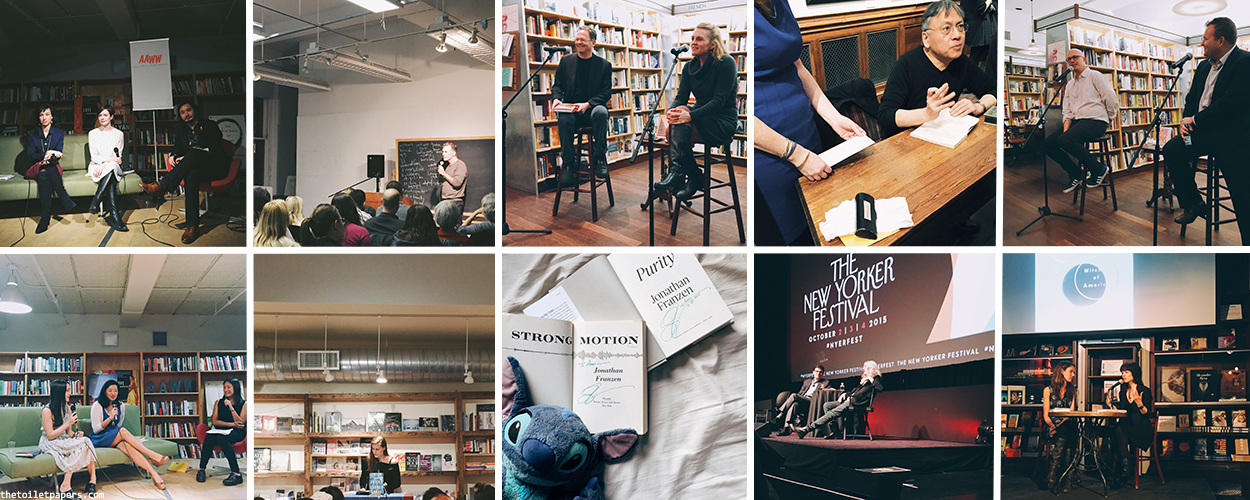
in 2015, i went to 38 book events and readings, and here are 10 i particularly enjoyed.

2015-events.jpg
  1. marie mutsuki mockett and emily st. john mandel with ken chen at AAWW
  2. michael cunningham at columbia
  3. meghan daum with glenn kurtz at mcnally jackson
  4. kazuo ishiguro and caryl phillips at the 92Y
  5. aleksandar hemon with sean macdonald at mcnally jackson
  6. alexandra kleeman and patricia park with anelise chen at AAWW
  7. lauren groff at bookcourt
  8. jonathan franzen with wyatt mason at st. joseph's college
  9. patti smith with david remnick at the new yorker festival
  10. alex mar with leslie jamison at housingworks bookstore

(both franzen events had no-photo policies.)


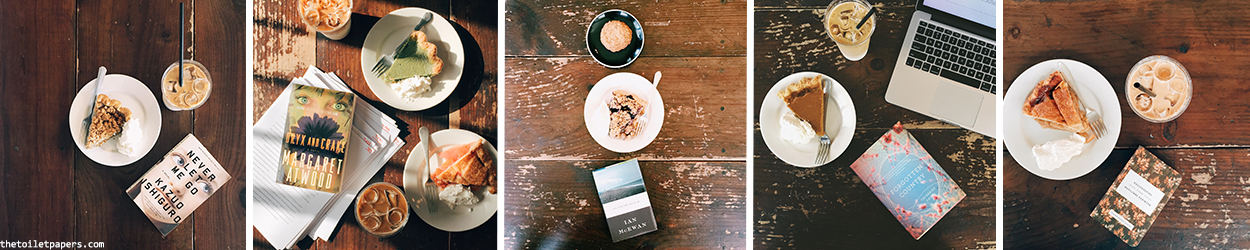
in 2015, i took 34 photos of books with pie.  mind you, this is not the number of times i ate pie.  this is simply the number of times i went to eat pie and decided to photograph it with the book i was reading at the time.  and by pie, i mean pie from four and twenty blackbirds because their pie is delicious and not too sweet and totally worth going to gowanus for (so, if you're in nyc, go get some!).

here are 5 photos of books with pie because it would be unnecessarily mean of me to torture you with all 34 slices of amazing pie, wouldn't it?

2015-pie.jpg

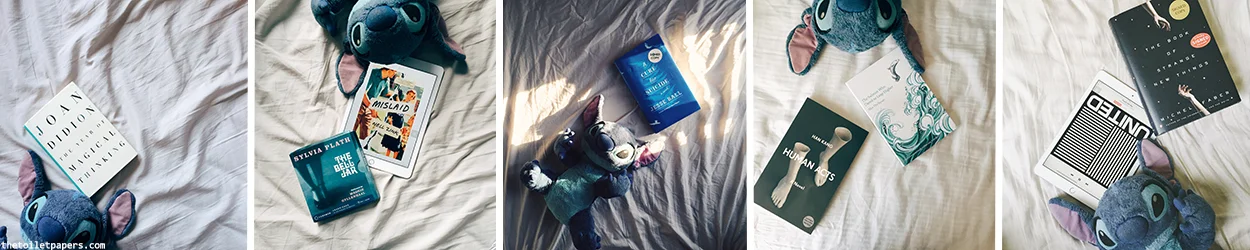
in 2015, i took 38 photos of books with stitch.

i suppose, to provide some context:  i love stitch.  lilo and stitch is one of my favorite movies (we're talking top 3 here).  i've had this stitch for 13 years.  i still shamelessly take him with me everywhere (he's in california with me right now).  obviously, he popped up every now and then with a book.

here are 5 photos of books with stitch.  i'm totally choosing how many photos to post arbitrarily (in multiples of 5, though, so maybe not so arbitrarily?).

2015-stitch.jpg

in 2015, my book club started, and we read 10 books.  we've now eased into a routine of meeting at my friend's apartment and having a potluck, but we were absent this routine the first two times we met, hence the three out-of-place photos.  i know; it's making me a little twitchy, too; but we'll have 12 consistent flat-lays from 2016!

2015-bookclub.jpg
  1. marilynne robinson, lila (FSG, 2014)
  2. alice munro, the beggar maid (vintage, 1991) (first published 1977)
  3. kazuo ishiguro, an artist of the floating world (vintage,1989) (first published 1986)
  4. margaret atwood, the stone mattress (nan a. talese, 2014)
  5. jeffrey eugenides, the virgin suicides (picador, 2009) (first published 1993)
  6. ta-nehisi coates, between the world and me (random house, 2015)
  7. virginia woolf, mrs. dalloway (vintage, 1992) (first published 1925)
  8. michael cunningham, the hours (FSG, 1998)
  9. nikolai gogol, the complete tales (vintage, 1999)
  10. nathaniel hawthorne, short stories (vintage, 1955)

(we combined two months, so i didn't have 10 photos, so i included the nachos i ate when we met to discuss munro's the beggar maid.)


in 2015, i became much more brutal with dropping books because life is too short for books that simply don't hold your interest.  i intentionally dropped 13 books.

2015-dnf.jpg
  1. claire messud, the woman upstairs (knopf, 2013):  so. boring. nothing. happens.
  2. cheryl strayed, tiny beautiful things (vintage, 2012):  i started reading this in earnest, but then i skimmed it with a friend, and then i never went back to it.  strayed’s columns are generally hit or miss for me.
  3. atul gawande, being mortal (metropolitan books, 2014):  this wasn’t what i was expecting it to be ... though i’m also not entirely sure what i was expecting it to be.  i think i was expecting more profundity, and i wasn’t taken by the writing.
  4. renee ahdieh, the wrath and the dawn (putnam, 2015):  omg, the sheer amount of adverbs in this made me want to throttle the book.  i always read with a pencil to mark passages i like or to jot down thoughts, but i read this with a pencil to cross out all the adverbs and circle all the different variations of “said” --  i want to ban her from using a thesaurus ever again.  and limit how many adverbs she's allowed to use.
  5. rebecca mead, my life in middlemarch (crown, 2014):  i really liked what i read of this, but i finished middlemarch and didn’t like that that much, so i never did finish the mead.
  6. rabih alameddine, an unnecessary woman (grove, 2014):  i just stopped reading this -- like, i put it down for the day and kind of forgot i’d ever started reading it, which was weird because i started reading it on oyster books and liked it enough that i bought the paperback … and then i never went back to it and probably never will.
  7. ta-nehisi coates, between the world and me (random house, 2015):  i know; i’m horrible for dropping this; but i did.  i never finished reading it for book club, and i didn’t finish it after book club and have no inclination to pick it up again.
  8. jesse ball, a cure for suicide (pantheon, 2015):  this tried too hard to be … whatever the hell it is.
  9. virginia woolf, mrs. dalloway (vintage, 1992):  ugh.  i'm sorry, michael cunningham, but UGH.
  10. emile zola, thêrèse raquin (penguin, 2010):  given the plot, this is going to sound bizarre, but i was bored to death with this.  it was so predictable.
  11. philip weinstein, jonathan franzen (bloomsbury, 2015):  given my unabashed, vocal love for franzen, you’d think i’d be all over this, but, as it turns out -- and i say this in the most non-creepy way possible -- i know way too much about franzen’s bio already.  also, my brain kept going off in all sorts of directions because it’s already full with my own critical analyses of franzen, and weinstein’s writing is very flat.  one day, i'll write about franzen.
  12. shirley jackson, we have always lived in the castle (penguin, 2006):  so. boring. nothing. happens.
  13. nathaniel hawthorne, short stories (vintage classics, 2011):  (no comment.)

in 2015, i took a lot of photos of books with food, and i am not going to count them all.  here are 5 i randomly chose so that i'd have 7 "in 2015"s instead of 6.

2015-food.jpg

and that's all, folks!  stay tuned for my year-end recap coming ... at some point in the next two weeks.  >:3  happy new year!