hello monday! (150413)

in his interview with the asian american writers' workshop's ken chen, kazuo ishiguro says:

i became interested in how people told the story of their own lives to themselves and how they deceive themselves.  how sometimes they wanted to look at shameful episodes from the past that they had participated in and other times they absolutely did not want to look at those things.

and 

the parent-child or any relationship tends to become dependent on some unspoken agreement not to go to certain memories, certain dark passages.  after a while, you start to ask, is our bond, is our love, based on something phony if it depends on things being kept hidden?

when i think about memory, i think of nell, my favorite band.  a few years ago, when they finally made a comeback after four years away, during a TV appearance, jong-wan (vocalist + songwriter) said:

예전에는 뭔가 잃는게 굉장히 두려웠던 것 같에요.  그리고 그게 되게 힘들고 … 근데 시간이 점점 지나면서는 내가 잃는 것 보다는 뭔가 잊어가고 있는 것들이 굉장히 슬프게 느껴지들아구요.  제가 예를 들어서 그 어떤 소중한 사람이 됐든 아니면 꿈이 됐든 그걸 잃어가는 것 보다는 내가 그런 것 자체가 있었다는 것 조차 잊어가는게 슾퍼서 아마 전반적인 앨범에 가사 내용이 좀 그런 내용이 아닌가 …

before, i think i was afraid of losing things.  and that was incredibly difficult … but, as time passed, instead of losing things, i started to feel more sadness about forgetting things.  for example, whether it’s an important person or a dream, instead of losing that, because i felt sad about forgetting that i even had such a person/thing, i think that’s why the lyrics on this album generally have that quality …*

for some reason, i've always thought of this in terms of memory, in losing memories versus forgetting memories.  there's a degree of willfulness attached to losing something, that there is some contributing action that leads to the loss, whereas forgetting happens when we don't mean for it to happen, when we want to hold onto something and keep it close, only to realize one day that what we so cherished has slipped away -- and, yet, at the same time, could we not see forgetting as a type of loss, too?  but, yet again, i wonder if this also is a way that english fails me because there is something so distinctive about these words in korean, to lose (잃는다) versus to forget (잊는다) that makes the comparison so poignant, so melancholy, so regretful.

the exploration of memory, though, is one reason i love ishiguro's books, especially when paired with his exquisite first-person and the nostalgic tones with which he imbues his books, and i'm interested in the new places his explorations of memory have taken him.  in the buried giant (knopf, 2015), there's a mist caused by a dragon that causes people to forget, but these memories aren't lost because they will be awakened again once the dragon has been slain.  when these memories are regained, tensions and conflicts will return to the land, which begs the question, is it better to forget then, to accept the loss instead of questioning it?  and, on a more intimate scale, is it better in a marriage, in a relationship, in a friendship to claim forgetfulness?  like ishiguro said to chen, where are the foundations then, and are they real and valid or fake?

how long can something be sustained when essential memories have been forgotten?

who are we when we've lost or forgotten our memories?  who are we to each other when we've lost or forgotten our memories?

nicole krauss explores this in her debut novel, man walks into a room (doubleday, 2002), in which the main character, samson, wakes up one day in las vegas, having somehow made his way out west from new york city, though he has no recollection of this.  as it turns out, he has a brain tumor, which has erased his memories since childhood, and, though his wife, anna, brings him back home post-operation healthy and physically well, nothing is familiar to him -- everything's been erased, lost, forgotten.  he is no longer the man she married and built a life with, and she is nobody to him, and their marriage cannot be sustained.

the truth, though, is that it doesn't necessarily take a brain tumor to lose or forget because, as humans, we're subject to change, and, sometimes, to maintain our relationships, we willfully lose or forget things.  or we simply lose or forget memories as we get older, become different people, and how regretful a prospect is that, sometimes, that this is something we can't help, and is it natural, then, that we've become a culture so obsessed with remembering, with curating our lives and preserving them on facebook, twitter, instagram, blogs, like, if we don't leave some record of ourselves behind, it'll be like we were never here, like we've never lived these lives?

"slip away" (from nell's album, slip away) ends:

혼자 남겨진 외로움보다, 
눈물로 얼룩진 마음보다,
뒤엉켜버린 그 시간보다, 
단 하나뿐인 그 진실보다,
잊혀져갈 이 모든 게 애처롭다
추억조차 지워갈 내 그 모습이 눈물겹다
익숙해질 그 모습이 눈물겹다

more than the loneliness of being left alone,
more than the heart spotted with tears,
more than that entangled time,
more than that singular truth,
all these things i'll forget are more painful,
the self that will erase every memory is more pitiful,
the self that will become accustomed to that is more pitiful.*

* all translations are mine; even if they are crappily done, i still claim ownership of them.


april is national poetry month, so here's a poem (or part of a poem) every monday for the rest of the month, which is really my way of saying, here's a poem by ted hughes.  today's is the end of one of my favorite poems, and i will leave you with this -- have a good week, all!

even in my dreams, our house was in ruins.
but suddenly -- the third time -- you were there.
younger than i had ever known you.  you
as if new made, half a wild roe, half
a flawless thing, priceless, facetted
like a cobalt jewel.  you came behind me
(at my helpless moment, as i lowered
a testing foot into the running bath)
and spoke -- peremptory, as a familiar voice
will startle out of a river's uproar, urgent,
close:  'this is the last.  this one.  this time
don't fail me.'

howls & whispers, "the offers"

march reads!

15march.jpg

fifteen.  allie brosh, hyperbole & a half (touchstone, 2013).

(no quote because i don’t have the book, sorry!  i borrowed it from a friend.)

read this in an afternoon in los angeles, and there were no surprises here — what you see on her blog is what you get here.  the book felt a little long, though; i found my interest significantly waning as i got closer to the end. 


sixteen.  asa akira, insatiable:  porn — a love story (grove press, 2014).

i stormed off set.  it takes a lot to get me that mad, but dan had done it.  i was tired of people trying to tell me the sexual orientation of my boyfriend.  no one was going to tell me my boyfriend was gay anymore.  in an industry where we were so often shunned from society because of our sexuality, you would think people would be more open-minded and understanding.  it made me sick.  ("penis envy")

asa akira’s a porn actress, and she wrote a memoir about, well, being a porn actress, and this was an easy read.  her writing is simple and casual, and she’s very frank and open and doesn’t try to cater to an audience — i got the feeling that she was writing insatiable more for herself than anyone else, though, at the same time, there wasn’t a cloying sense of “this is a diary,” either.

i’ve read reviews/comments about insatiable being shallow or lacking in introspection or deflecting from deeper thought about issues like asian fetishization or homophobia in the straight porn industry or personal things like her family, and i’m torn about this.  on one hand, yes, it would have been interesting if she’d delved deeper, but, on the other, i don’t know — as far as her relationship with her family’s concerned, we aren’t owed that, and, as far as issues in the porn industry are concerned, do we need that — or, from another perspective, why do we require that?

i didn’t feel that the book was lacking much because of the lack of introspection, but maybe that’s because i went into insatiable expecting a fun, breezy read with blunt sex talk.  i will say that i found the last bit (her letter to her future child) a little too flippant and defensive (and most telling, in ways) for me, but, otherwise, i enjoyed it for what it was, a casual memoir by a woman who works in porn and enjoys her work.


seventeen.  joy cho, blog, inc.  (chronicle books, 2012).

authenticity simply means writing in a voice that comes naturally to you, and posting things that you simply want to share with others — not what you think they want to see.  (39)

i picked this up because i spent a lot of the last few weeks thinking about what to do with my blog and wondering how the hell people made money off their blogs and, yes, if i might be able to do something more with my little corner on the internet.  a lot of the stuff about blogging in blog, inc., wasn’t new to me, but i was glad for the chapters about monetizing blogs and what things like analytics or SEOs and such were.  i love cho’s blog, oh joy!, and her sunny, approachable personality is very present in this book, which is also laid out well and designed beautifully and filled with interviews with other bloggers (these were my favourite parts).  in the end, i still don’t know what i’m doing with this blog, but that’s okay — i’m glad i picked this up and have it as a resource.


eighteen.  jonathan franzen, the kraus project (FSG, 2013).

sex looks like nothing or like everything, depending on when you look at it, and it must have been looking to me like nothing in munich, at the predawn hour when you’re finally exhausted by unsatisfied desire and only want to sleep a little.  not until i was back in my clothes and standing on a train platform in hannover, a few hours later, hurling pfennings, did it look like everything again.  (250-1)

this is a book of franzen’s translations of karl kraus, along with annotations and commentary from himself, paul reitter (kraus scholar) and daniel kehlmann (austrian novelist + kraus fan) — okay, so, i’m going to confess to a sort of bad thing and say that i didn’t read all the kraus essays.  :|  i started reading the kraus project when it was published in autumn 2013, but i put it down until march 2015, and i have a habit of not going back to reread things to refresh my memory, so … i never went back to figure out where i’d left off in the kraus essay and merrily proceeded to read all the commentary.

… i’m sorry, franzen.

i thought the kraus project was kind of cool, and i loved the dialogue in the annotations between reitter, kehlmann, and franzen.  there seems to be a deep camaraderie there, which i enjoyed; they approached kraus seriously, thoughtfully, intellectually without being pedantic or teacherly; and i liked how they sometimes build on each other and ultimately created this living, communal project that encourages the reader, too, to engage (yes, even without having read all the kraus).  i found the kraus project to be an interesting experience, and i look forward to revisiting it and maybe giving the kraus essays another go.

also, this was one beautifully designed book.  (cue:  whathappenedwithpurity.)  (and cue:  five months to purity!)


nineteen.  roxane gay, an untamed state (grove/atlantic, 2014).

"it is often women who pay the price for what men want."  (mireille)

read this on oyster books (which i am loving) — i wrote about this in a hello monday post, and i don’t know if i want to expand on it more.  except maybe to say that, wanting better writing does not mean wanting flowery, beautiful writing.  it just means wanting better writing, and i wanted better (much better) writing from an untamed state.  not beautiful writing.  better.


twenty.  miriam toews, all my puny sorrows (mcsweeney’s, 2014).

on the way back to the hospital i thought about my crazy outburst in the parking lot.  it’s my past, i say out loud to nobody in the car.  i had figured it out.  i was sigmund freud.  mennonite men in church with tight collars and bulging necks accusing me of preposterous acts and damning me to some underground fire when i hadn’t done a thing.  i was an innocent child.  elf was an innocent child.  my father was an innocent child.  my cousin was an innocent child.  you can’t flagrantly march around the fronts of churches waving your arms in the air and scaring people with threats and accusations just because your family was slaughtered in russia and you were forced to run and hide in a pile of manure when you were little.  what you do at the pulpit would be considered lunatic behavior on the street.  you can’t go around terrorizing people and making them feel small and shitty and then call them evil when they destroy themselves.  you will never walk down a street and feel a lightness come over you.  you will never fly.  (177-8)

this is a novel about two sisters.  the elder is a brilliant pianist, and the younger is “ordinary” — she’s been twice married, twice divorced, with two kids and a decent (basic?) writing career.  the brilliant pianist is suicidal and wants to die, and her sister struggles to come to terms with this, whatever “coming to terms with this” means — and all of this meant i was, one, instantly interested and, two, intensely wary.

i’m wary of portrayals of depression and suicide because i’m wary of reductive caricatures, a lack of sympathy/empathy, dismissive condescension.  i also generally avoid writing of/by people who’ve lost loved ones to suicide, so i walked into all my puny sorrows with a whole lot of reservation, ready to close the book and move on at any given point.  the voice sucked me in, though — the novel is told by the younger sister, yolandi, and there is so much personality and vivacity in her voice that i couldn’t help but be invested in her story, in her relationship with her sister and mother, in her conflicting emotions and thoughts about what to do for her sister.

toews’ portrayal of suicidal depression is remarkably nuanced and human, withholding in judgment and simply portraying the person within, but, surprisingly, i think i appreciated more how she conveyed the complicated nature of caring for someone who’s suicidal.  yolandi is faced with heavy questions, questions whose answers might have seemed obvious in hypothetical situations but become more complex in the face of her sister’s real desire to die, and her grief, too, is complicated, not a static thing but one that goes through cycles and emotions, rage one instant, deep sorrow the next, normality in yet another.  it’s this humanity that grounds the novel and pulled me in and left me at the end satisfied, even though the book did go on a little long.


twenty-one.  alice munro, the beggar maid (vintage, 1991).

the most mortifying thing of all was simply hope, which burrows so deceitfully at first, masks itself cunningly, but not for long.  in a week’s time it can be out trilling and twittering and singing hymns at heaven’s gate.  and it was busy even now, telling her that simon might be turning into her driveway at this very moment, might be standing at her door with his hands together, praying, mocking, apologizing.  memento mori.  (“simon’s luck,” 173)

i also wrote about the beggar maid in the same hello monday post linked above, and i don’t know if i want to write more about it here.  i’m not being lazy, i swear — i honestly don’t have much to add to it, which leaves me feeling conflicted and leads me to …

it’s been a weird reading year thus far.  i find myself hungry to read constantly, and i’ve been reading a lot and consistently, but, while i’ve been having several strong, intense reading experiences, i’ve found much of my reading kind of falling away from me once i’m done.  an untamed state was like that; the beggar maid also fell away from me once i’d completed it; and hyperbole and a half, too, had zero sticky factor (though i wasn’t much surprised by that, to be honest).  i’ve admittedly found it a bit discouraging, that i can be so invested in a book while i reading it, only to emerge from it and essentially forget about it.

though that wasn’t the case with the beggar maid, so maybe i should have brought this up after writing about it …

to be honest, if i hadn’t been reading the beggar maid for book club, i wonder if i would have finished it.  it’s not that i don’t see the merits in munro’s writing, but there’s a staticity and flatness to her stories that wear me down and leave me wanting more.  i thought about marilynne robinson when i was reading the beggar maid, and particularly of lila, how there’s a provinciality to robinson’s gilead, too, but how robinson’s stories feel bigger than that, seem to encompass so much more and transcend the narrowed focus of her characters and stories.  i don’t think it’s a novel versus short story thing because i still found much of the beggar maid static, but i wonder if it isn’t a tone thing because there was a distance to munro’s writing in the beggar maid, a lack of connection that kept me at arm’s length from rose and made me see her more as a series of actions/movements than an emotive, expressive person.

which isn’t to say that all characters should be emotional or expressive, just that i couldn’t get a gauge for anything below the surface or the sense that rose was simply a quiet, reserved woman or even that she was suppressing things.  she was simply there on the page doing things, so there wasn’t much there for me to hold onto as a reader.  i do like munro’s writing, though; it’s quite lovely.

april thus far has been a great reading month.  selfish, shallow, and self-absorbed has given me plenty to mull over, and the book of strange new things haunted me for days (and still fills me with despair when i think about it).  the ghost network was loads of fun and excitement (though let’s see about the sticky factor), and i’m absolutely loving the faraway nearby (and can’t wait to acquire/read a field guide to getting lost next) — and i’m not sure where i’ll go after that, so we’ll see!

as always, thanks for reading!

hello friday! (150410)

150410.jpg

hello hello!  it feels like it's been a long week, partly because i was away for two days and partly because i haven't been sleeping well, so i'm constantly tired.  it's been a great reading week, though, so i can't complain!

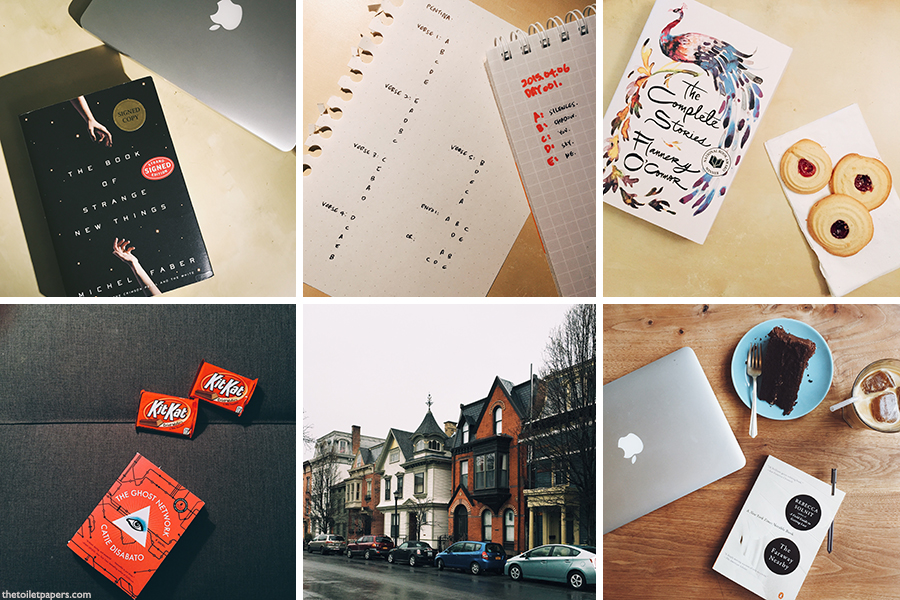
i finished reading the book of strange new things and picked up flannery o'connor's the complete stories -- and isn't it beautiful???  FSG recently reissued her books with these beautiful covers, and i want to collect them all.  and i want to know what happened with purity ... any beautiful cover art FSG releases now, and that's the first thing that pops into my head, "this is so gorgeous! ... whathappenedwithpurity."  it's going to be a Thing from 2015, maybe even the Thing!

instead of taking o'connor's the habit of being with me to hudson, i took catie disabato's the ghost network and devoured it in less than twelve hours.  i would have devoured it in one sitting, but i started reading around midnight and was bone-tired from not having slept much the night before and taking the train and walking around, so i had to succumb to sleep with fifty pages left to go, which i was loathe to do, but, sometimes, your body wins out.  the ghost network was loads of fun, though, and so well-written, and i loved all the stuff with guy debord and the situationists because i studied them in college and wrote about the society of the spectacle, so the book also stirred up all these nostalgic *feels* for my comp lit days -- but, anyway, nostalgia aside, the ghost network is fabulous, and i can't recommend it enough.  it's out next month from melville house, y'all!  go check it out!

in hudson, my friend and i went to check out the local bookstore (obviously) where i picked up rebecca solnit's the faraway nearby and promptly started scarfing it down before making myself slow down and take it morsel by morsel because, oh my god, it is so, so good.  i love her writing, and i love how she writes about writing because, here, read this:

writing is saying to no one and to everyone the things it is not possible to say to someone.  or rather writing is saying to the no one who may eventually be the reader those things one has no someone to whom to say them.  matters that are so subtle, so personal, so obscure, that i ordinarily can't imagine saying them to the people to whom i'm closest.  every once in a while i try to say them aloud and find that what turns to mush in my mouth or falls short of their ears can be written down for total strangers.  said to total strangers in the silence of writing that is recuperated and heard in the solitude of reading.  is it the shared solitude of writing, is it that separately we all reside in a place deeper than society, even the society of two?  is it that the tongue fails where the fingers succeed, in telling truths so lengthy and nuanced that they are almost impossible aloud?

[...]

sometime in the late nineteenth century, a poor rural english girl who would grow up to become a writer was told by a gypsy, "you will be loved by people you've never met."  this is the odd compact with strangers who will lose themselves in your words and the partial recompense for the solitude that makes writers and writing.  you have an intimacy with the faraway and distance from the near at hand.  like digging a hole to china and actually coming out the other side, the depth of that solitude of reading and then writing took me all the way through to connect with people again in an unexpected way.  it was astonishing wealth for one who had once been so poor.

("flight," 64-5)

her writing style isn't flowery or prose-y; it's simply plain good.  she isn't sentimental or outright funny, but there's this wonderful warmth to her writing that i find encouraging and reassuring, a wisdom that makes her feel like a mentor -- and the faraway nearby makes me think of selfish, shallow, and self-absorbed in that i derive a lot of comfort from them both because they make me feel less alone, place me in a world where there are other people, other writers, who are out there struggling with similar thoughts and similar passions and similar ambitions, the word "similar" used in very loose ways.  both books have been recent reminders that we read to feel less alone, that books are and/or contain companions, that we are somehow in this (whatever "this" is) together.

i also started reading amy rowland's the transcriptionist via oyster books, and i'm enjoying it thus far.  for some reason, i keep picturing an older setting, like the 1950s, 1960s, so i keep having to resituate myself in contemporary times, but, in this case, i wonder if that's a bad thing -- but let me continue reading this and ruminate upon what i mean by that some more.  (and see if i continue feeling so as i get deeper into the book.)

and, well, there's my week-in-review.  it's been a great reading week and a terrible writing week.  and, yes, i know, i still owe y'all a march recap, and it will be up by the end of the weekend, and i can actually say this in good faith this time because i was up until four a.m. this morning trying to finish it.  it's not quite as polished or thorough as i'd like, though, so i shall finish working on it and post it over the weekend!  thanks for being patient!

(sometimes, i wonder who i'm talking to here ... hi, readers!  or hi, myself?  have a great weekend!  i'm going to be eating all the chocolate i can find my hands on.  and do some spring cleaning, the konmari way!)

hello monday! (150406)

mmm, so, the monthly recap did not get written over the weekend (clearly), but, in my defense, i was still (am still sorta) recovering from a bad sinus cold.  i'm also going out of town tomorrow for an overnight trip, so shall we say march books will be up by thursday evening?  yes?  ok!


last week, i read michel faber's the book of strange new things (which is easily one of the most beautiful books i have laid my eyes upon) with a friend on instagram, and we finished over the weekend.  i spent the last 50 pages sobbing my eyes out because the oasans had burrowed their way into my heart to an extent unbeknownst to me until i started crying and could not stop, and the book has sat with me these last two days, which i dare say is a pretty good thumbs-up as far as an endorsement of the book goes.

i particularly appreciated how faber wrote peter (the main character and the missionary to oasis) -- faber wasn't judgmental of peter, even when peter really started exhibiting the more gnarly parts of legalistic christianity, but neither did he try to soften the edges and try to make peter more "likable" (for lack of a better word).  i liked that peter was human even in the ways that he internalizes his faith; he is so many legalistic, self-absorbed christians i know and have grown up knowing; and, in many ways, i found the book of strange new things to be refreshing in its presentation of faith, while also being fascinating for not having a particular slant either way.  peter is who he is; faith is what it is; and it is up to the reader to make his/her own judgment.

(or maybe this is me being sensitive to faith and expecting disparaging views toward faith and religious people in books [and pretty much everything].  there is also that.)


themes i respond strongly, viscerally, emotionally to in books:  loneliness, siblings, loss.


tonight (monday night), i went to hear jennifer weiner who gave a talk titled "how to be authentic on social media" as part of pen america's DIY series.  this shall be the write-up from the talk because i wrote down exactly three things:

  1. weiner made a defense for twitter as being a place where writers can practice, to try out new things and essentially get feedback because followers will respond so you can get a sense of what works and what doesn't -- and i wrote this down because i don't particularly agree with this.
  2. emily gould (who joined weiner in conversation after the talk) likes birds and knows about birding!  (i did not know this!)  she likes people best then cats ... then birds are somewhere there.
  3. gould said she agreed with about 98% of what weiner said about twitter but disagreed with about 2%, part of which was that she thinks that it should be okay for writers who aren't comfortable with twitter not to be on twitter (and with which i vehemently agree).

weiner was exactly as i expected -- funny, personable, gregarious with lots of digs directed at franzen -- but, ultimately, i am a non-[public-]tweeter, and i find all this "if you want to be a writer now, you have to be on social media" thing immensely discouraging.  but neither does it compel me to get on twitter ...  however, i am an instagram fiend, and i think that's quite enough.


the 2014 vida count is out and ... what can i say about it that hasn't been said yet.


i'm going out of town tomorrow for an overnight trip and am looking forward to it, to hopping on a train and getting away for thirty-six hours.  i'm taking flannery o'connor's the habit of being (her letters) with me, and i like how blunt she can be -- or i suppose "blunt" might not be the right word, but o'connor doesn't necessarily play in niceties, and i appreciate that.

i should end this here and pack or something, but i feel like lingering.  i'm feeling a bit soul-weary tonight, a little lonely, and i'm thinking that maybe i should reread something because i'd like to sink into an old friend, seek out the comfort of something familiar and warm and safe.  what to read, what to read -- i guess we'll see what my heart lands upon on friday!

have a great week all!  and, if you're in the nyc area, enjoy spring!

hello friday! (150403)

150403.jpg

a week-in-review then, because i'd still like to post something on fridays and books are the most comfortable (and obvious) choice!

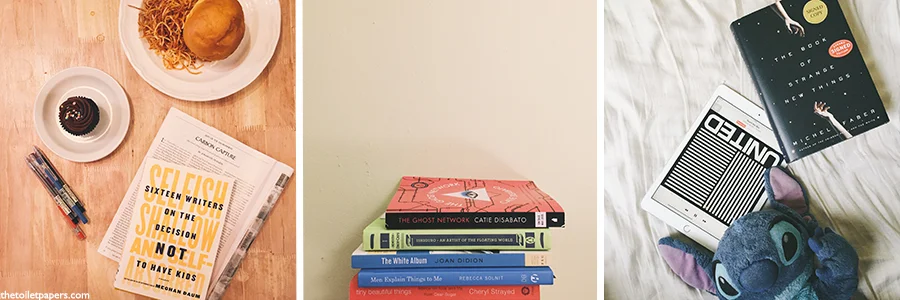
  • i finished reading selfish, shallow, and self-absorbed (picador, 2015) today.  favorite essays were those by sigrid nunez, anna holmes, danielle henderson, jeanne safer, and elliott holt.
    • i would've loved to see an essay or two by people in their late-twenties/early-thirties because i think (or, at least, i like to think) that you can be in your late-twenties and early-thirties and have decided not to have kids -- some of us have known this about ourselves since we were young.  
    • someone (i'm pretty sure it was laura kipnis) on the panel of contributors at the event on tuesday said there seemed to be a preponderance of writers defending that they liked kids, and, having finished the collection, i agree that there is.  i don't doubt that they genuinely love children; sometimes, though, it did feel very defensive; and i admit it was refreshing to come across the writer who baldly said s/he didn't like kids.  (this was mostly personal, though; it's hard in general to come across someone who doesn't like children.)
  • this week, i started doing a buddy read of michel faber's the book of strange new things (hogarth, 2014) with a friend on instagram.  this is one of the reasons i can't dismiss social media; i've had the pleasure of meeting some incredible people via the internet; and i love the fact that this friend (who lives in japan) and i can actively read a book together.
  • speaking of the book of strange new things, faber writes with such ease, and his prose is natural and lovely.  his descriptions are vivid and alive, too -- i dreamt i was on oasis because i'd been reading right before going to sleep, and it felt so real, the humidity, the atmosphere, the colors, that i woke up feeling kind of disoriented, wondering, wait, that wasn't real?
  • books i've been reading off-and-on the last few weeks (yes, weeks):  
    • cheryl strayed's tiny beautiful things (vintage, 2012):  when i was in LA, the illustrator friend and i went flipped through all the columns, and i haven't felt very inspired to go back and give them all a thorough reading.
    • rebecca solnit's men who explain things to me (haymarket books, 2014):  i'm thrilled this was reissued in hardback with new essays! 
    • joan didion's white album (FSG, 2009):  i love lingering over my didion, taking little morsels and letting them melt into me.  (i'm not quite sure how to credit these publication years ... right now, i'm going with when the edition i own was issued.)
    • kazuo ishiguro's an artist of the floating world (penguin, 2013):  there's such a lovely tension and unease simmering through this book that i'm afraid to find out what the narrator did during the war.  this is my book club's next selection, though, so i'll have to grit my teeth and find out!
    • catie disabato's the ghost network (melville house, 2015, forthcoming):  this is a cheat; i found this ARC at housing works on tuesday and was so very excited; so i had to share.

march reading recap will be up by the end of the weekend!  have a great weekend, all!