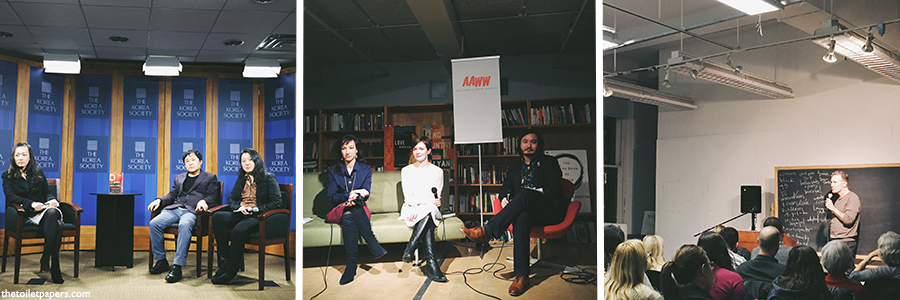
laura van den berg with catherine lacey @ mcnally jackson!

lvdb_cl

today's event!  launch event (?) for laura van den berg's debut novel, find me.  when i first saw the event on the mcnally jackson calendar weeks ago, i immediately thought that laura van den berg and catherine lacey would make this freakishly perfect pairing ... and i was right.

  • lacey described find me as "freaky," and berg loved it
  • the core of the story was always more the personal dystopia of joy (the narrator) (who's going through life in a haze, trying not to feel).  it took a cataclysmic event to strip down her walls.
  • lacey:  "why is florida so fucked up?"  berg:  "florida transcends any sort of explanation."
    • apparently, in florida (or in berg's part of florida), it's normal for alligators to show up in your backyard.  there's a hotline you call when that happens, and the anagram for the hotline is SNAP.
  • when she thought of find me as a 2-part story, she couldn't think of it as a short story --> the architecture of the story as being pivotal
  • the biggest different between a novel and a short story --> process
    • she can work on a short story anywhere, even on the subway or in the bathroom at a party
    • couldn't do that for the novel -- she had to go away to summer residences to work on it
    • "a novel, it wants your life."
  • she doesn't save drafts.  she deletes them or edits on them.  she likes the clean start.
    • (my note/comment:  as someone who obsessively archives her drafts, this is SO WEIRD to me.  O_O)
  • "i'm drawn to books that pull from different worlds and put them in one place."

hello monday! (150216)

was laid up with (what i assume was) the flu last week/over the weekend, which means i was bedridden for four days, which means i read a whole lot because there wasn't much else to do when i wasn't sleeping or thinking i was dying ... which is maybe a tad melodramatic, but i'm alone here in new york, and being sick alone is really just pure misery.

(my mum called to check in on me every day and took advantage of the situation to get in her, see, this is why you should move back to california bit to which i replied, no, this is why i need a husband.)

(this is why i'm flying out to california for a week next month.  there's nothing like getting the flu alone to make any grown person want family.)  (and tacos.)

it kinda goes without saying that it was a great reading week:  plowed (and i mean plowed) my way through kim thúy's mãn (random house canada, 2014), jenny offill's dept. of speculation (knopf, 2014), patricia park's re jane (viking, forthcoming 2015), and megan whalen turner's the queen of attolia (harpercollins, 2001), made significant headway into caitlin doughty's smoke gets in your eyes (norton, 2014), and listened to jonathan franzen's the discomfort zone (FSG, 2006).  i loved the characters of the queen of attolia so much that i had to pop in at mcnally jackson yesterday (the first time i left my flat in four days, and what a glorious, freezing day it was) and buy its follow-up, the king of attolia (greenwillow books, 2006).

that was a lot of titles in one paragraph.

sometimes, these posts are easier to write, and, other times, i sit here staring at the blinking cursor on my screen and think, now what?  what is there i want to say?  today is one of those latter days, maybe because it's so fucking cold outside  or because i've still got the remnant lingering congestion and cough from the flu or because i'm back to editing my manuscript which inevitably consumes much of my life.

so links!  let's do links!  i've wanted to do a post of links for a while!

thanks for hanging around, and have a great week!

hello monday! (150209)


feeling like shit tonight, so i cracked open jenny offill's dept. of speculation and a pint of haagen-dasz' cookies and cream, which is damn near impossible to find, mind you.  figured the combination of the two of them could help fend off these convictions of colossal failure because, god, melodramatic is apparently now my default state of being, and tonight's a particularly bad night.

on page 7, it says:

i found a book called thriving not surviving in a box on the street.  i stood there, flipping through it, unwilling to commit.

you think that the mental anguish you are experiencing is a permanent condition, but for the vast majority of people it is only a temporary state.

(but what if i'm special?  what if i'm in the minority?)

i write a lot about suicide, which means i think a lot about suicide, and i think about how being suicidal isn't sometimes a continued, prolonged state.  i think of it as cycles, as ups and downs, except the downs aren't simply downs but a single, profound thought resonating in your brain, your body, your heart -- i want to die -- and you keep coming back to this, maybe not everyday but continually, constantly, always thinking of when and where would be best because, when it comes to dying, you need a plan.  sometimes, it's not about executing the plan but simply about having one in place, a sort of emotional protective net to fall back on because it's comforting, knowing that there's an alternative out there, that there's always that thing you can do when all of this -- whatever this is -- loses every shred of meaning.

(sometimes, i think about faith and how it shouldn't be so easy to reconcile the two.  i think about God and the church and how it's constantly failed the depressive, the mentally ill, the suicidal, and i think there's nothing to reconcile -- we will continue to struggle with this pain, and the church will continue to fail us, and God -- i suppose God will be there for those of us who believe in whatever capacity we choose to believe.)

and i think about how, no, this "mental anguish" has nothing to do with permanence or temporality because there are good days and then there are bad days and it's never a comfort to hear everything will be all right! or you'll be okay! because what the hell does anyone know, please take your goddamn platitudes elsewhere.  and maybe i shouldn't be writing blog posts when i'm feeling like shit (and why did my "hello monday" posts get so personal, anyway), but it also feels good to be able to write about suicide and what i think about suicide without the cloak of fiction, so at least there's that.

i also haven't read much at all over the past week because i find myself unable to commit to a book at the moment.  hopefully, i'll get more into dept. of speculation and finish it over the next few days.  and i received kim thuy's mãn and alex ross' listen to this over the weekend and purchased michael cunningham's the hours, joan didion's the white album, and patricia park's re jane (i might have a problem, this is true), so let's read more this week -- there's such a wealth of worlds and beauty and humanity in these blocks of paper bound between pieces of cardboard (or thicker paper), which helps me derive infinite comfort in the knowledge that i will always have books, that my melodramatic shit has made them even more important in my life, and, for me, that is sufficient.

(also, the cover of the hardback of dept. of speculation is beautiful, so what the fuck happened to the paperback?  had to order this off the internet because i just could not have the hideous paperback cover.)

(if you're reading this post, this blog, thanks for reading.  i really, really mean that.)
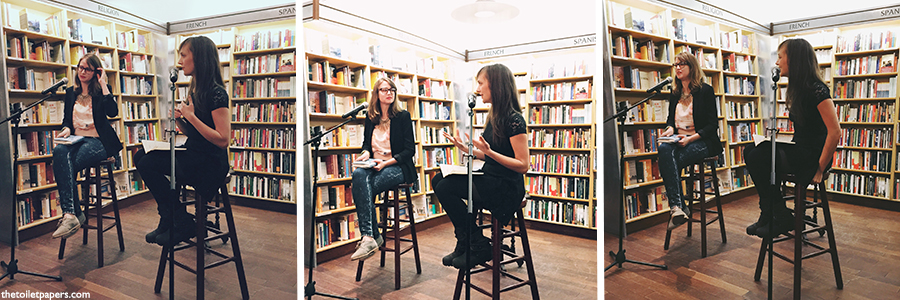
jang jin-sung + marie mutsuki mockett & emily st. john mandel + michael cunningham

it was an unusually packed week of events -- three in a row!  (this is highly unusual.)

jang jin-sung @ the korea society (2015 february 2)

the korea society puts on some really, really great events.  last summer, they held an event with roberta cohen, co-chair of the committee for human rights in north korea, and jo jin-hye, a north korean refugee, and, on monday, they hosted an event with jang jin-sung, former poet laureate of north korea who had to flee because he lent a friend a book from south korea and his friend left his bag (with the book, which was obviously highly confidential) on the subway.

this event was particularly interesting because jang was part of the elite in north korea and, therefore, has a different perspective.  he worked for the united front department, where he created propaganda material that was intended to create sympathy among south koreans for north korea, and was gifted a rolex by kim jong-il at one point.  and, yes, this was a book event because jang wrote a memoir, dear leader, that was published last year.

  • the united front department was created at a time north korea was confident about unifying korea under kim jong-il.  when jang joined, this was no longer considered feasible, so the department started looking into north korea.
  • kim jong-il wasn't picked for succession.  he was placed in the propaganda department, not in a governmental position (if he'd been picked for succession, he would've been given a governmental position), but this turned out to be pivotal for him -- it's where he learned the power of narrative control.
  • was very surprised by jang sung-taek's execution -- north korea is a system that's built on the supreme leader being infallible, and the execution shattered that.
  • after kim jong-il's death, weird political plays began happening, which fractured the monopolization of power.  the execution statement said that jang sung-taek had been trying to become prime minister of north korea, and he had been trying to gain power along economic lines.  it is assumed that kim jong-un ordered the execution, but it was actually the power-holders of the OGD (organization and guidance department), and there have been no power conflicts since the execution.
  • kim jong-il built power through his network of close friends.  kim jong-un's is built on his position as kim jong-il's son.  thus, kim jong-il's was a total apparatus of power, while kim jong-un's is merely a title.  
  • argues that the only solution for north korea is reunification
  • the world needs to change how it views north korea.  if kim il-sung wore full body armor, kim jong-il only wore frontal armor, and kim jong-un is naked save for a tiny little shield.  and yet the world is still so focused on attacking that shield -- basically, north korea has changed, but the world's approach to it has not.
  • north korea has already been conquered by the US dollar.
  • north korea seeks dialogue because it's only through dialogue that they can make threats, extort, etcetera.
  • north korea operates on a two-prong strategy:  to cooperate on land but maintain tension on sea.  you can't see something like the cheonan sinking as solely an act of provocation but as a result of the dynamics of north korean/south korean relations -- because south korea kept giving, north korea had to keep upping the tension/psychological warfare to maintain its leverage.
  • if the cult of kim keeps being attacked, north korea will keep responding.  the system relies on defending the legitimacy and supremacy of the leader no matter what.

also, i think interpreters are so badass.  the ease with which they turn language around in their brains so quickly ... it's incredible!


marie mutsuki mockett & emily st. john mandel @ asian american writers' workshop (2015 february 3)

mockett wrote a book called where the dead pause and the japanese say goodbye.  read an excerpt from it here!  emily st. john mandel wrote the fabulous station eleven.

  • ken chen (director of AAWW)'s pithy summation of cormac mccarthy's the road:  when a disease takes over the world and turns it into boy's life magazine.
  • mandel:  there's something in art that reminds us of our humanity.  as a species, we're kind of hard-wired to find that grace.
  • mandel researched pandemics and was able to find a kind of hope in how it happened again and again.  ("so the apocalypse has already happened.") (i forgot who said that.  it might have been chen posing it as a question.)
  • mockett:  while she was in japan, she went to see a shaman who would supposedly be able to channel her father (mocket's father passed away).  she wasn't really sure what to expect or believe of this shaman, but she realized that it wasn't that the shaman could literally channel her father but that the shaman's aim was to help her, to help people through their suffering and learn essentially to live and be happy.
  • mandel:  the idea of the museum came out of the idea that we already do this.  there's something very human about collecting weird little things.
  • mockett:  in the writing of this book, she wanted to capture the things she found precious and unique about japan because, who knows, it could all disappear.
  • mandel:  donna tartt's the secret history is kind of her model because it's kind of the perfect novel -- it's beautifully written, but it's also a page-turner.
  • mockett:  two secrets for structure in her book:
    • she didn't have a book (model) in mind.  she was definitely influenced by japanese structure, though -- or lack of structure.  she doesn't really like structure because structure is another of those things we can play with, but she came up with the idea to follow the cycle of the soul, starting with death and going from there.
    • she has a handful of jazz musician friends, so she was also thinking of the book like a setlist, like a gig.
  • mandel:  she found herself looking at the fragility of the world in a way she hadn't.  "this whole apparatus of civilization that surrounds us is incredibly fragile."

it's such a pleasure listening to mandel read.  i'd been weirdly hesitant to pick up station eleven until i went to a reading and heard her read the "an incomplete list" passage (pages 31-2) -- it's a haunting, beautiful passage, and she reads it so wonderfully.


michael cunningham @ columbia university (2015 february 4)

michael cunningham!  he's such a gracious, generous soul, and it was a delight to hear him as part of the creative writing lecture series at columbia.  (i also love going to columbia; the campus is beautiful; and i don't ever trek up there so i like the excuse.)  the lecture series doesn't really provide a structure (i don't think), so he used the time to create characters with the audience and show how that led to formation of a plot/narrative.  it was pretty cool.

  • he opines that any fully-imagined character in conjunction with another fully-imagined character can't not form a plot/narrative.  (and he went on to demonstrate this.)
  • after the basic questions (gender, race, job, family, etcetera), the oft-unasked questions:
    • what does s/he most ardently want?
    • what is s/he most afraid of?
    • what's standing in his/her way?
    • what is it s/he most doesn't want you to know?
  • what characters want -- desire drives fiction, even if what they want is invisible to them.
  • there's no such thing as plot; there are only human beings trying to get something they want and the world keeping it from them, whether through external forces or self-sabotage, etcetera.
  • when creating, tends to start with the physical, with the body.
  • sometimes, if possible, tells students to out and pick a person and follow him/her (don't stalk, though) and come back with a list of twenty physical traits.  it's amazing how often a full human being with a soul will come out of that.
  • if you sufficiently imagine the corporeal, you summon someone.
  • "we walk bold and unafraid into the cliche."
  • you set it up (the characters and such) ... and then you wait for the surprise.
  • a sort of measure of success is when the novel doesn't turn out to be the novel you started writing.  if there's no surprise for the author, then how could there be any for the reader?
  • he writes probably twice the length of the published book and likens it to taxes:  i owe the government half my income, so i owe the wastebasket half my pages.
  • writing is a collaborative process.  you should have a team of readers.  three or four is a good number.  twelve is too many, and one is too few.

hello monday! (150202)

i've been thinking about burdens -- the burdens of authors, of readers, of literature -- because i stumbled across a paper* (or something) written about a topic i admit i don't remember (which makes this a terrible introduction) -- what i remember was a mention of chang-rae lee and how he fails to "give back" to korea/korean-america (based off his debut novel, native speaker; i do remember the paper was written before a gesture life).  i probably should have actually read this paper to ascertain the writer's point more clearly, but it was honestly just that claim that stuck with me because i couldn't help but wonder, but what does it mean?  to "give back" to your ethnic community?  and is that a burden that should fall on authors [of color]?  and in what ways?  to what extent?

i've been thinking about the burden of literature, too, how certain books are given more weight than others, and how that can or might affect how we decide about what we read, like in feeling obligated to pick up certain books.  and how that in and of itself could influence how we read certain books, burdened as we are with all this attached "goodness" and "worthiness" -- and maybe this sounds foolish and of no consequence, but do you ever wonder why you read the things you do?

two friends and i touched on this topic this past weekend over brunch, and it reminded me of what chang-rae lee said at his reading at greenlight a few weeks ago -- that we should interrogate ourselves as readers.  (okay, he was talking in the context of himself as a writer also interrogating himself as a reader, but i think we should all interrogate ourselves as readers.)  a few years ago, i had to make the conscious effort to read outside my comfort zone, to read more diversely, because, for one, i felt like i'd fallen into a rut in my reading life and, for another, why was i reading so much from one group when there is such a richness of reading material available?  and i could still stand to challenge myself further, but it's been a better reading life thus far, i dare say, though now  i'm trying to loop this back to the burden of literature and kind of struggling to do so ...

*  i most likely grossly misrepresented this paper, for which i sincerely apologize.


i come from a world that openly and vocally dismisses the novel as something that has no use or value.  the novel is a mark of immaturity because mature, grown people move on from the novel and read essays and philosophy and non-fiction (or, rather, they read books on faith and how to live a good christian life and such) because essays and philosophy and non-fiction (or theology and religious discourse and christian thinking) have a "tangible" use in "furthering" and "bettering" them and helping them "grow."

to which i say, how small your minds are, when the worlds of novels contain multitudes, the stories we might not want to hear because they pain us or disgust us or shame us, the histories that others have sought to erase, the voices that have been silenced or exploited or manipulated.  when novels wrestle with what it is to be human in all its complications and richness and lay bare for us the spectrum of human longing and suffering and love and the universality of the human condition -- we are not so different from each other as some might have us, might desire us to believe.

and, to those who dismiss the novel and toss christian texts in my lap, i say, well, christ understood the value of stories, too.


was that a lot for a monday post?  it's been a long week, though, and i find myself a bit weary.  the blizzard last week was anticlimactic, tapering off before getting anywhere close to the foot or two or three of snow we were supposed to receive.  there was snow, though, eight inches of it, and i did so revel in it because, like i said, i love snow, and the world is a magical place after snow.

and then it turns to slush.  and/or ice.

one of my closest friends is visiting the city this weekend, and i'm loads excited for it.  we're going to eat and walk and visit all my favorite places, and we're going to talk about books and our stupid, foolish ambitions and the good wife.  she's probably going to freeze because she's from california, and i'm going to laugh because i told her to buy a beanie (she's refusing), and she's probably going to declare her hatred of new york city vehemently over and over again, and i'm going to laugh some more.  all while we eat and walk and eat and walk some more ...

basically, it's going to be a good weekend.  >:3

(and i already broke my resolution to read a book in korean every month ... damn!)